Statement of Regret on Tax Reform for Prevention of Stock Price Suppression
- The Ministry of Finance and Economy's tax reform proposal and the FSC/Korea Exchange's disclosure of the low-PBR list both raise serious concerns about policy effectiveness
- The government's proposal grants amnesty to numerous low-PBR companies and falls far short of the investor protection pursued by the President Lee and the National Assembly
- Investor expectations for the tax reform were exceedingly high; many will be deeply disappointed
- Our estimates indicate that only 84~87 KOSPI companies would be subject to the reform, with an average current PBR of 0.26x. The vast majority of low-PBR companies appear likely to escape the reform's scope
- A PBR below 1x, regardless of industry, means the share price is lower than the liquidation value — a fundamental disqualification for a listed company that should never have been listed in the first place
The KCGF expresses deep concern regarding the tax reform proposal titled "Improvement of the Valuation Method for Listed Stocks Suspected of Stock Price Suppression," publicly released by the Ministry of Finance and Economy (MoFE) on August 3th. The stated rationale for the reform — preventing the avoidance of inheritance and gift taxes through stock price suppression — is clear in intent. The government's proposal is scheduled to undergo deliberation in the National Assembly by the end of November.
However, a careful examination of the details gives rise to a reasonable suspicion that certain listed companies suspected of stock price suppression may hire smart lawyers and tax experts with the company’s money (the majority of which belong to ordinary shareholders) to evade the scope of the reform. The detailed criteria for the "Low-PBR Company Disclosure System" announced by the Financial Services Commission (FSC) and the Korea Exchange on July 28th raise similar concerns about policy effectiveness.
This legislation fails entirely to fulfill President Lee Jae Myung's directive on July 15th, in which he emphasized that capital market normalization is a matter of paramount national policy importance and called for expedited passage of the stock price suppression prevention law. In our view, the reform proposal further falls short of embodying the spirit of the amended Korean Commercial Code, which seeks to "protect the interests of all shareholders and ensure equitable treatment of shareholder interests."
The current administration achieved Commercial Code amendments through three difficult rounds of revision in order to protect shareholder rights. Yet the proportion of companies with a PBR below 1x — where market capitalization is less than net assets (book value) — has expanded to 70% of all listed companies. Investor expectations for the tax reform were extraordinarily high; the government's proposal will be perceived as a retreat in reform commitment, and many will be deeply disappointed.
The Forum notes with particular concern the abandonment of the general principle of selecting the bottom 25% across all KOSPI and KOSDAQ companies in favor of a non-traditional methodology that sub-classifies companies into 11 industries according to the GICS (Global Industry Classification Standard) — a framework typically employed by international professional investors — and then selects the bottom 25% within each industry. While consultation with chaebol lobbying clubs and businesses is valuable, public officials must prioritize the legislative purpose and public interest from a macroscopic perspective rather than becoming mired in individual issues.
Most controlling shareholders receive coaching from law firms and meticulously devise succession plans over a period of 10 to 20 years. For them, boosting the share price by simultaneously announcing positive news — such as dividend increases or share buybacks — at the time of releasing semi-annual earnings results on two occasions during the 6.5-year evaluation period is not a difficult task, in our opinion.
Consequently, the reform's criterion for identifying suspected stock price suppression — a PBR in the bottom 25% by industry (KOSPI) or bottom 10% (KOSDAQ) in 12 of the most recent 13 semi-annual periods — will likely highlight only the technical sophistication of the legislation while producing an exceedingly negligible effect in preventing the infringement of general shareholders' rights by controlling shareholders. In practice, the actual tax burden amounts to only 1.3x the valuation at the time of inheritance or gifting, and moreover, this structure creates an incentive to further depress the share price at the benchmark valuation date.
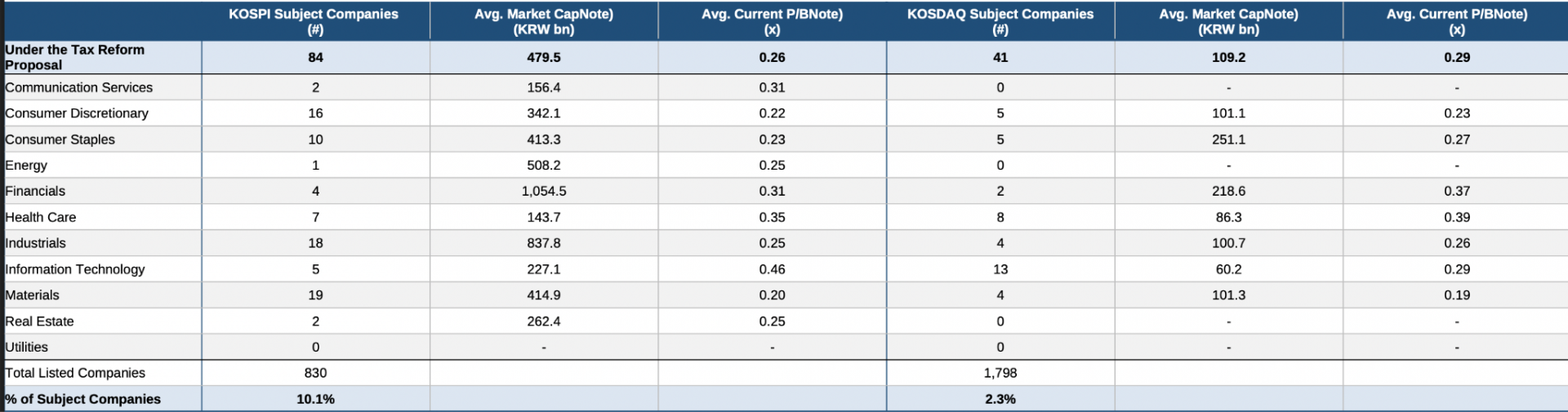
The KCGF, in collaboration with our domestic and international member firms, estimated the number of companies meeting the MoFE Reform Criterion 1 — "a PBR in the bottom 25% by industry (KOSPI) or bottom 10% (KOSDAQ) in 12 of the most recent 13 semi-annual periods." Based on recent earnings and share prices, the estimated number of subject companies is merely 84~87 for KOSPI and 43 for KOSDAQ, totaling approximately 130 companies. The average market cap of these companies is Won480bn for KOSPI and Won109bn for KOSDAQ. The average current PBR of subject companies is 0.26x for KOSPI and 0.29x for KOSDAQ. As shown in the table below, most large and mid-sized enterprises will be excluded according to our calculation. Notable names include Lotte Holdings, GS, DL, Taekwang Industrial, Hanwha Life, Daishin Securities, E-mart etc.
It is difficult to gauge how deeply the MoFE deliberated on the rationale of the reform. A mere 30% premium is inadequate: applying a 30% premium to the average PBR of 0.26x for the 84~87 KOSPI companies yields only 0.34x. Under the government's proposal, the higher of (a) the average closing price over the most recent 6.5 years and (b) the current valuation method plus a 30% premium is to be used. This structure may paradoxically create a greater incentive for controlling shareholders to suppress share prices more aggressively over an extended period.
Given Korea's industrial structure, where manufacturing is central, the use of PBR as one of the valuation methods for listed stocks is appropriate. In particular, capital-intensive industries such as semi, auto, batteries, steel, and petrochem routinely employ PBR as the representative valuation metric. PBR varies by industry and fluctuates with cyclical ups and downs, as evidenced by recent semiconductor price swings. Nevertheless, in the Korean reality where the median PBR of 10 of the 11 GICS industries (excluding IT) falls well below 1x, selecting the bottom 25% within each industry rather than targeting the bottom 25% of the overall market (approximately 210 to 220 companies) effectively grants amnesty to a multitude of low-PBR companies.
A PBR below 1x, regardless of industry, means the share price is lower than the liquidation value. This constitutes a fundamental disqualification for a listed company — one that is obligated to allocate capital efficiently and pursue the interests of all shareholders — and such companies should never have been listed in the first place. The reason is straightforward: the shareholders' required rate of return (which, from the company's perspective, represents the cost of equity capital) exceeds the return on equity. Banks offer fixed deposit rates; bonds have yield-to-maturity. Shareholders, too, have a required rate of return, yet 70% of Korean listed companies fail to meet it, which is why most trade below 1x PBR. By contrast, a recent NYU analysis of approximately 5,500 U.S. companies reveals an average PBR of 5.1x, with only 2 of roughly 110 industries trading below 1x book value.
When a founder(s) lists a company, they are making the decision to accept outside shareholders as business partners. Regardless of industry, controlling shareholders and management of listed companies must make every effort to ensure that market value (share price) exceeds NAV. The board's core responsibility is to determine the appropriate level of equity through sound capital allocation — capex, R&D, M&A, dividends, and share buybacks. When these conditions are met, Korean listed companies can comfortably exceed 1x PBR regardless of industry or business cycle. Nucor, a leading U.S. steelmaker, trades at 2.7x PBR; Dow at 1.4x; and P&G at 6.2x.
Rather than devising various artful mechanisms to appease the anticipated tax resistance of controlling families, the government should focus on how to normalize the distortion of equity markets and the national economy caused by the systematic abuse of capital markets for substantive tax evasion. The KCGF urges the government to approach this issue from a macroscopic perspective, including the rationalization of inheritance and gift tax rates and the introduction of a financial investment income tax for better harmonization of tax across various asset classes.
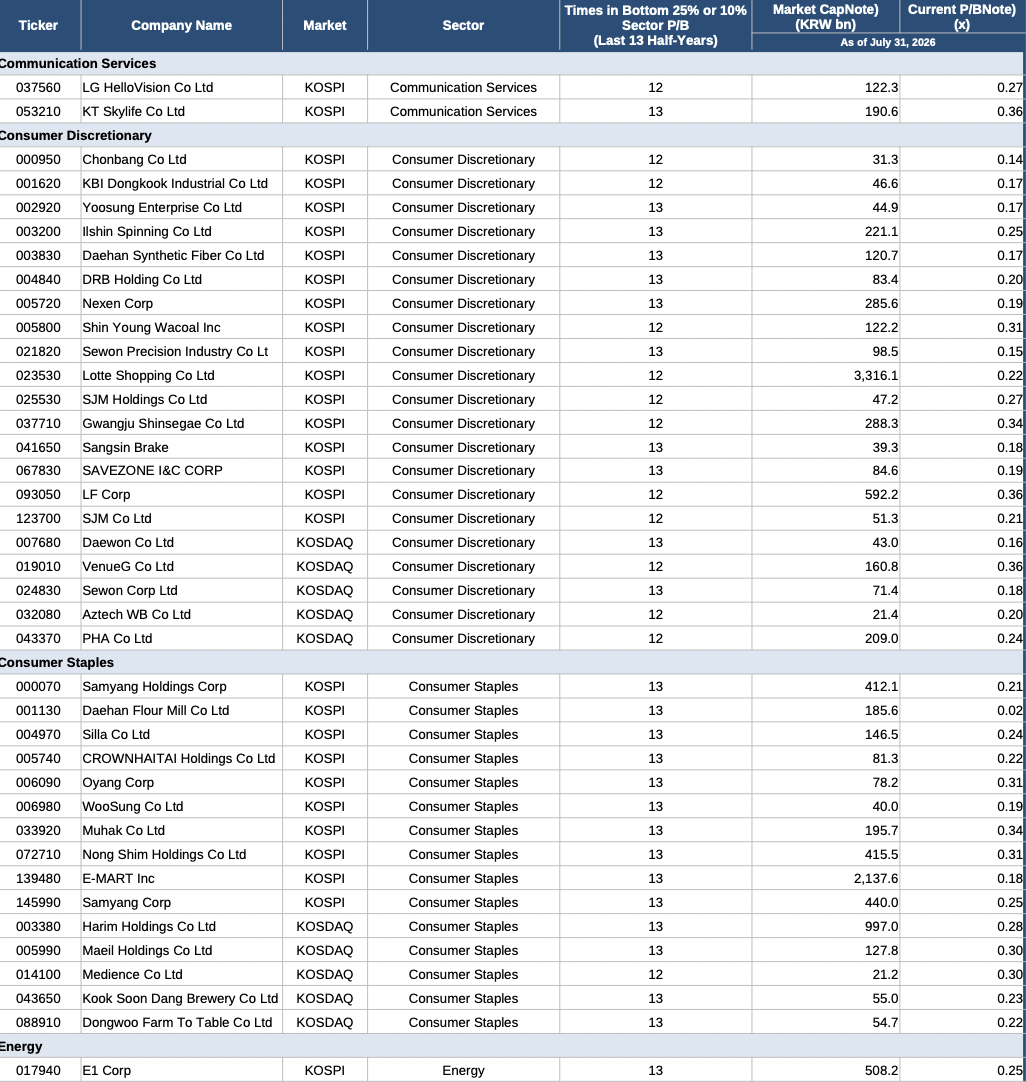
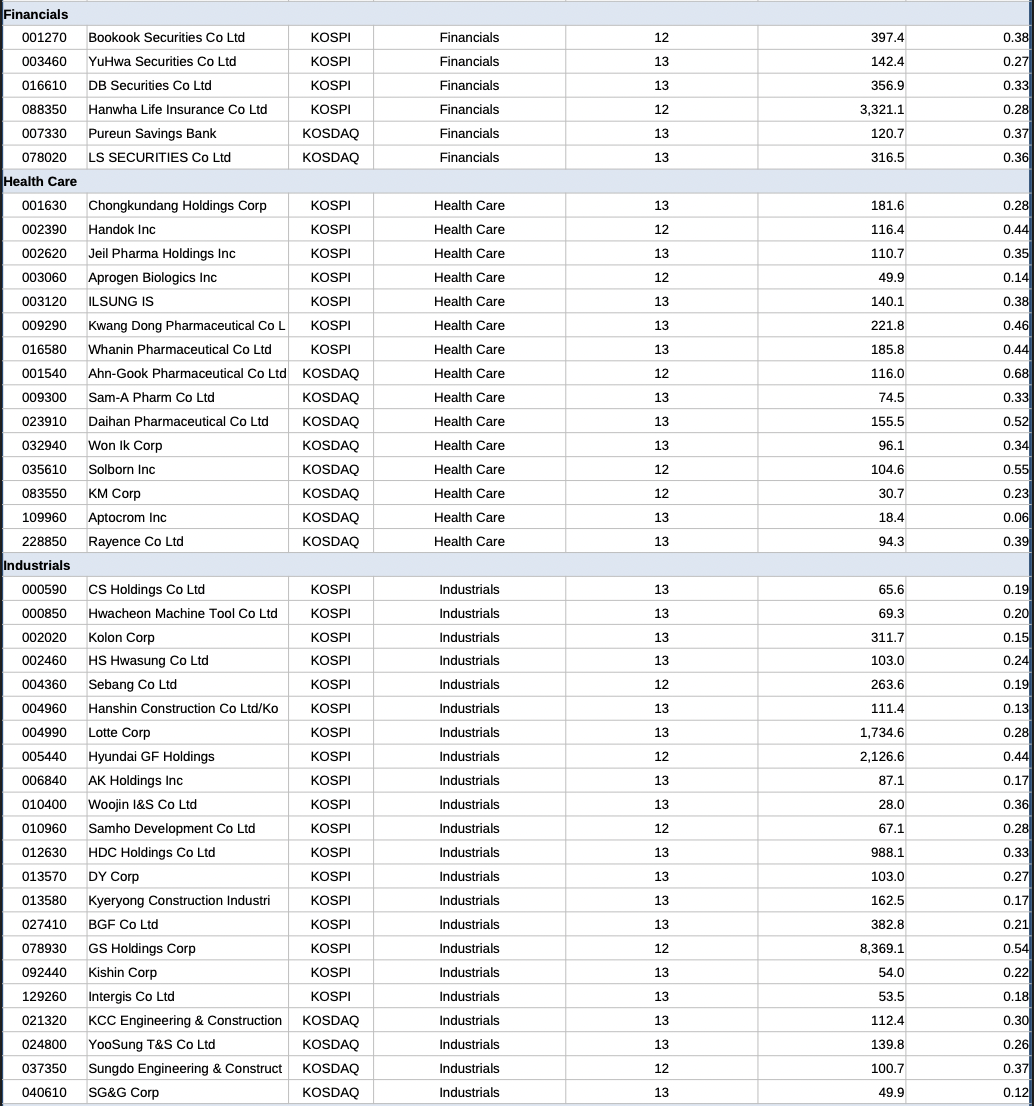
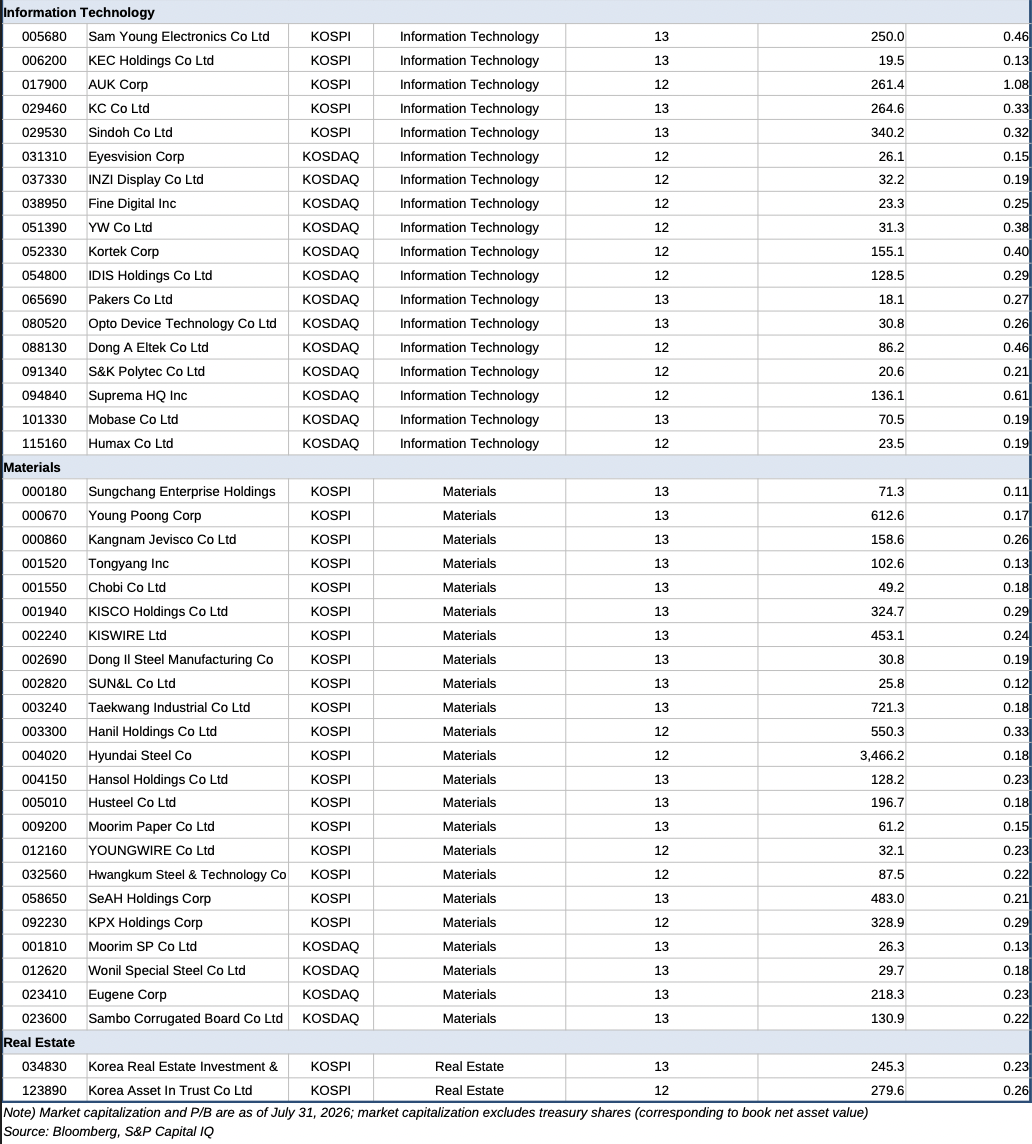
Table: List of KOSPI companies meeting MoFE Reform Criterion 1 — "a PBR in the bottom 25% by industry in 12 of the most recent 13 semi-annual periods" (estimated 84 companies in total; treasury shares deducted from market cap calculation)
August 24th, 2026
Korean Corporate Governance Forum
Chairman, Namuh Rhee




Statement of Regret on Tax Reform for Prevention of Stock Price Suppression
The KCGF expresses deep concern regarding the tax reform proposal titled "Improvement of the Valuation Method for Listed Stocks Suspected of Stock Price Suppression," publicly released by the Ministry of Finance and Economy (MoFE) on August 3th. The stated rationale for the reform — preventing the avoidance of inheritance and gift taxes through stock price suppression — is clear in intent. The government's proposal is scheduled to undergo deliberation in the National Assembly by the end of November.
However, a careful examination of the details gives rise to a reasonable suspicion that certain listed companies suspected of stock price suppression may hire smart lawyers and tax experts with the company’s money (the majority of which belong to ordinary shareholders) to evade the scope of the reform. The detailed criteria for the "Low-PBR Company Disclosure System" announced by the Financial Services Commission (FSC) and the Korea Exchange on July 28th raise similar concerns about policy effectiveness.
This legislation fails entirely to fulfill President Lee Jae Myung's directive on July 15th, in which he emphasized that capital market normalization is a matter of paramount national policy importance and called for expedited passage of the stock price suppression prevention law. In our view, the reform proposal further falls short of embodying the spirit of the amended Korean Commercial Code, which seeks to "protect the interests of all shareholders and ensure equitable treatment of shareholder interests."
The current administration achieved Commercial Code amendments through three difficult rounds of revision in order to protect shareholder rights. Yet the proportion of companies with a PBR below 1x — where market capitalization is less than net assets (book value) — has expanded to 70% of all listed companies. Investor expectations for the tax reform were extraordinarily high; the government's proposal will be perceived as a retreat in reform commitment, and many will be deeply disappointed.
The Forum notes with particular concern the abandonment of the general principle of selecting the bottom 25% across all KOSPI and KOSDAQ companies in favor of a non-traditional methodology that sub-classifies companies into 11 industries according to the GICS (Global Industry Classification Standard) — a framework typically employed by international professional investors — and then selects the bottom 25% within each industry. While consultation with chaebol lobbying clubs and businesses is valuable, public officials must prioritize the legislative purpose and public interest from a macroscopic perspective rather than becoming mired in individual issues.
Most controlling shareholders receive coaching from law firms and meticulously devise succession plans over a period of 10 to 20 years. For them, boosting the share price by simultaneously announcing positive news — such as dividend increases or share buybacks — at the time of releasing semi-annual earnings results on two occasions during the 6.5-year evaluation period is not a difficult task, in our opinion.
Consequently, the reform's criterion for identifying suspected stock price suppression — a PBR in the bottom 25% by industry (KOSPI) or bottom 10% (KOSDAQ) in 12 of the most recent 13 semi-annual periods — will likely highlight only the technical sophistication of the legislation while producing an exceedingly negligible effect in preventing the infringement of general shareholders' rights by controlling shareholders. In practice, the actual tax burden amounts to only 1.3x the valuation at the time of inheritance or gifting, and moreover, this structure creates an incentive to further depress the share price at the benchmark valuation date.
The KCGF, in collaboration with our domestic and international member firms, estimated the number of companies meeting the MoFE Reform Criterion 1 — "a PBR in the bottom 25% by industry (KOSPI) or bottom 10% (KOSDAQ) in 12 of the most recent 13 semi-annual periods." Based on recent earnings and share prices, the estimated number of subject companies is merely 84~87 for KOSPI and 43 for KOSDAQ, totaling approximately 130 companies. The average market cap of these companies is Won480bn for KOSPI and Won109bn for KOSDAQ. The average current PBR of subject companies is 0.26x for KOSPI and 0.29x for KOSDAQ. As shown in the table below, most large and mid-sized enterprises will be excluded according to our calculation. Notable names include Lotte Holdings, GS, DL, Taekwang Industrial, Hanwha Life, Daishin Securities, E-mart etc.
It is difficult to gauge how deeply the MoFE deliberated on the rationale of the reform. A mere 30% premium is inadequate: applying a 30% premium to the average PBR of 0.26x for the 84~87 KOSPI companies yields only 0.34x. Under the government's proposal, the higher of (a) the average closing price over the most recent 6.5 years and (b) the current valuation method plus a 30% premium is to be used. This structure may paradoxically create a greater incentive for controlling shareholders to suppress share prices more aggressively over an extended period.
Given Korea's industrial structure, where manufacturing is central, the use of PBR as one of the valuation methods for listed stocks is appropriate. In particular, capital-intensive industries such as semi, auto, batteries, steel, and petrochem routinely employ PBR as the representative valuation metric. PBR varies by industry and fluctuates with cyclical ups and downs, as evidenced by recent semiconductor price swings. Nevertheless, in the Korean reality where the median PBR of 10 of the 11 GICS industries (excluding IT) falls well below 1x, selecting the bottom 25% within each industry rather than targeting the bottom 25% of the overall market (approximately 210 to 220 companies) effectively grants amnesty to a multitude of low-PBR companies.
A PBR below 1x, regardless of industry, means the share price is lower than the liquidation value. This constitutes a fundamental disqualification for a listed company — one that is obligated to allocate capital efficiently and pursue the interests of all shareholders — and such companies should never have been listed in the first place. The reason is straightforward: the shareholders' required rate of return (which, from the company's perspective, represents the cost of equity capital) exceeds the return on equity. Banks offer fixed deposit rates; bonds have yield-to-maturity. Shareholders, too, have a required rate of return, yet 70% of Korean listed companies fail to meet it, which is why most trade below 1x PBR. By contrast, a recent NYU analysis of approximately 5,500 U.S. companies reveals an average PBR of 5.1x, with only 2 of roughly 110 industries trading below 1x book value.
When a founder(s) lists a company, they are making the decision to accept outside shareholders as business partners. Regardless of industry, controlling shareholders and management of listed companies must make every effort to ensure that market value (share price) exceeds NAV. The board's core responsibility is to determine the appropriate level of equity through sound capital allocation — capex, R&D, M&A, dividends, and share buybacks. When these conditions are met, Korean listed companies can comfortably exceed 1x PBR regardless of industry or business cycle. Nucor, a leading U.S. steelmaker, trades at 2.7x PBR; Dow at 1.4x; and P&G at 6.2x.
Rather than devising various artful mechanisms to appease the anticipated tax resistance of controlling families, the government should focus on how to normalize the distortion of equity markets and the national economy caused by the systematic abuse of capital markets for substantive tax evasion. The KCGF urges the government to approach this issue from a macroscopic perspective, including the rationalization of inheritance and gift tax rates and the introduction of a financial investment income tax for better harmonization of tax across various asset classes.
Table: List of KOSPI companies meeting MoFE Reform Criterion 1 — "a PBR in the bottom 25% by industry in 12 of the most recent 13 semi-annual periods" (estimated 84 companies in total; treasury shares deducted from market cap calculation)
August 24th, 2026
Korean Corporate Governance Forum
Chairman, Namuh Rhee