The Name Itself Needs Fixing — "Mandatory Tender Offer Rule" Should Be "Mandatory Private Benefits Transaction Rule"
- The acquisition of a 30–60% partial stake carrying control is common in Korea but is not M&A by global standards — it is a transaction in the controlling shareholder's private benefits
- Foreign selling of Korean equities in recent months reflects not only concerns about the semiconductor cycle but also anxiety over a possible policy U-turn in the capital market. This is deeply regrettable. International investors point out that long-term investment is difficult in countries with weak investor protection. Every foreign investor I have met recently has expressed opposition to the introduction of a Korean-style mandatory tender offer rule, which runs counter to directors' duty of loyalty to shareholders
- The Forum argues for the purchase of all remaining shares (100%). Depending on the deal structure, the mandatory tender offer volume can be zero share for minority shareholders
- If the Capital Markets Act amendment passes the National Assembly, a share price collapse following any partial-stake transaction carrying control is a certainty. Look at the Aekyung Industrial case, where minority shareholders were left stranded
- Samsung Electronics, Samsung Biologics, and other Korean companies, when abroad, mostly acquire 100% of the shares through a tender offer in control-carrying M&A, in line with global standards
- TPG plans to acquire control of Lotte Rental and its 61% controlling stake by combining its own equity investment with acquisition financing, and to tender for the remaining shares — an actual case that rebuts the argument that mandating a full 100% purchase would shrink the local M&A market due to the acquirer's funding burden
According to the disclosure of November 7th 2025, EQT signed a share purchase agreement to acquire a 23% controlling stake in the software company Douzone Bizon together with a 14% stake held by Shinhan Securities, for a total of W1.3158 tr. On the day of disclosure, Douzone's share price plunged 11% to close at W82,800, wiping out W322bn in market cap. The sellers, including Chairman Kim Yong-woo, would dispose of their entire holdings at W120,000 — a 27% premium to the November 5th closing price. The essence of this contract was that it was not a sale of the entire company, but a transaction in which the 38% held by the controlling shareholder and the Shinhan Securities’ funds was transferred together with control.
In advanced economies such as the US, such transactions are not called M&A; they are classified as transactions for the private benefits of the controlling shareholder, and are strictly distinguished from the sale of an entire company. When controlling shareholders or managers monopolise benefits that are not shared with other stakeholders such as minority shareholders, this is called "private benefits of control."
In Korea, partial-stake acquisitions are classified as ‘M&A’ but this is a misconception. In the US, both Wall Street and academia do not recognise partial-stake acquisitions as M&A at all. By global standards, "private benefits transaction" is the accurate expression. (Fortunately, EQT later acted in the spirit of the amended Korean Commercial Code — not only acquiring the 38% partial stake together with control, but also making a tender offer to Douzone's general shareholders at W120,000 and then conducting additional on-market purchases to secure over 95% of the shares, completing a voluntary delisting on July 15th.)
The Capital Markets Act amendment bill centred on introducing a mandatory tender offer rule, which was held back ahead of the National Assembly main session on October 1st, needs to be corrected starting with its name. Although it specifies in the statute the activation threshold ("where a person acquires 25% or more of the shares and becomes the largest shareholder") and the target equity stake of the tender offer ("50% + 1 share or more of the issued shares"), it does not at all realise the purpose of guaranteeing general shareholders the opportunity to sell their shares on the same terms when control of a listed company is acquired.
Do the provisions permitting “prior purchase” and “the 50% + 1 share rule” mean abandoning the principle of shareholder equality emphasised by the amended Commercial Code and the OECD Principles of Corporate Governance? The OECD Principles identify "equitable treatment of all shareholders, including minority and foreign shareholders" as a core element of governance.
The recent concentrated selling of Korean stocks by foreign investors is the result of reflecting not only concerns about the semiconductor cycle but also unease about the possibility of a policy U-turn in the capital market. This is deeply regrettable. International investors point out that long-term investment is difficult in countries with weak investor protection. Every foreign investor I have met recently has expressed opposition to the introduction of a mandatory tender offer rule, which runs counter to directors' duty of loyalty to shareholders.
The Forum argues for the purchase of all remaining shares (100%). In the KCGF Opinion on September 17th, we recommended: "Legislate the obligation to make a tender offer for all remaining shares, as a matter of principle." The purpose of the rule — guaranteeing all general shareholders an exit opportunity equal to that of the controlling shareholder — does not hold under a 50% + 1 design. In practice, a paradox arises in which the larger the controlling shareholder's stake, the smaller the opportunity received by general shareholders. Depending on the deal structure, the mandatory tender offer volume can even be zero shares. For example, if a controlling shareholder with 40%, friendly shareholders with 8%, and institutions with 3% are acquired together off-market in a prior purchase to secure 51%, the mandatory tender offer volume for the remaining 49% held by general shareholders becomes zero.
The mandatory tender offer rule was proposed via formal bill by nine MPs in the 22nd National Assembly, and a majority — including MPs. Kang Hoon-sik, Kim Hyun-jung, and Park Hong-bae — specified the purchase of all remaining shares. MP Park Hong-bae stated that 100% does not mean "buying every share unconditionally," but giving all general shareholders the opportunity to sell on the same terms as the controlling shareholder. Likewise, pro-rata allocation means that, in reality, it is not in fact a 100% purchase.
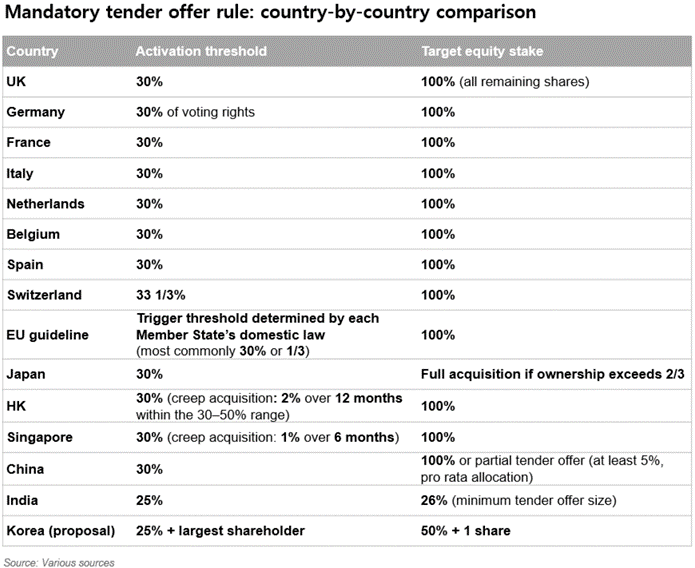
Looking at the country-by-country comparison table (see below) of mandatory tender offer rules below, one can see that Korea is the only country that departs from the global standard while simultaneously driving the purpose of the regime into self-contradiction. By target equity stake, the UK, Germany, France, the Netherlands, Spain, Switzerland, Italy, Hong Kong, and Singapore all require 100%. The US has no mandatory tender offer regime, yet minority shareholder protection works because of three devices: 1) a strong disclosure regime; 2) the best-price rule — in a tender offer, all shareholders must be able to sell at the same highest price; and 3) the principle of entire fairness review. Australia has no concept of a mandatory tender offer, but where only the controlling shareholder's stake is traded, approval from general shareholders is required through a Majority of Minority (MoM) vote. If Korea introduces a mandatory tender offer rule with the acquisition target designed at 50% + 1 share, it will be a structure equipped with none of the devices of the US or Europe — that is, a strict trigger with very thin protection.
If the Capital Markets Act amendment passes the National Assembly main session with the prior-purchase permission and the 50% + 1 share provisions kept intact, the collapse in the value of shares held by general shareholders after any partial-stake transaction carrying control will be patently obvious. On the day in 2011 that CJ Group was selected as the preferred bidder for CJ Logistics (formerly Korea Express), Korea Express' share price fell by the 15% daily limit. On October 21st 2025, after disclosure of a contract under which a Taekwang Group consortium would acquire a 63% stake in Aekyung Industrial together with control for W470bn (W28,190 per share), Aekyung Industrial's share price fell from W15,000 to W10,610, a loss of 30%. The current price is 62% below the price at which the controlling shareholder transferred its partial stake together with control at a premium.
Korean companies, unlike at home, mostly acquire 100% of the shares in control-carrying M&A abroad, in line with global standards. Harman, which Samsung Electronics acquired in the US in 2016 for a total of $8bn ($112 per share in cash), was the largest overseas M&A by a Korean company at the time. Every Harman shareholder was given the opportunity to sell at the same price, including a 28% premium, after which 100% of the shares were acquired. It is a representative case in which Samsung Electronics acquired the entire stake at the same price for all shareholders, even though the UnS has no tender offer regime. Samsung Biologics also announced in July this year a tender offer to acquire control and the entire stake of the Swiss peptide CDMO PolyPeptide Group AG. General shareholders handed their shares to Samsung Biologics at the same price (CHF 44.31) as the controlling shareholder holding 56%. This is the result of Switzerland's best-price rule. A total of 98% of the shares tendered. The acquisition price is known to be CHF1.46bn (approximately W2.7tr), including a 40% premium to the closing price immediately before the tender offer rumours (CHF 31.65).
The argument that mandating a full purchase would shrink the local M&A market due to the acquirer's funding burden is unpersuasive. In Japan, the M&A market has in fact become very active over the past two to three years, driving the stable growth of the Japanese stock market. The view that the M&A market carries an excessive capital burden appears to have no basis, given that the local acquisition finance market has already grown and is active. TPG recently acquired control of Lotte Rental and a 61% stake for W1.3105tr, and in the overall transaction — including a future tender offer for the remaining shares — is known to be raising funds with its own equity and acquisition financing arranged in parallel by KB Securities and others. International investors do not agree at all with the claim by some that the M&A market will shrink due to the acquirer's funding burden. Rather, I would hope that Korean companies take this opportunity to abandon the bad habit of octopus-like expansion by acquiring only 30–40% stakes. This is the 21st century, and what is needed is focus and execution — concentrating on core areas while taking 100% of the shares.
November 3rd, 2026
Korean Corporate Governance Forum
Chairman, Namuh Rhee




The Name Itself Needs Fixing — "Mandatory Tender Offer Rule" Should Be "Mandatory Private Benefits Transaction Rule"
According to the disclosure of November 7th 2025, EQT signed a share purchase agreement to acquire a 23% controlling stake in the software company Douzone Bizon together with a 14% stake held by Shinhan Securities, for a total of W1.3158 tr. On the day of disclosure, Douzone's share price plunged 11% to close at W82,800, wiping out W322bn in market cap. The sellers, including Chairman Kim Yong-woo, would dispose of their entire holdings at W120,000 — a 27% premium to the November 5th closing price. The essence of this contract was that it was not a sale of the entire company, but a transaction in which the 38% held by the controlling shareholder and the Shinhan Securities’ funds was transferred together with control.

In advanced economies such as the US, such transactions are not called M&A; they are classified as transactions for the private benefits of the controlling shareholder, and are strictly distinguished from the sale of an entire company. When controlling shareholders or managers monopolise benefits that are not shared with other stakeholders such as minority shareholders, this is called "private benefits of control."
In Korea, partial-stake acquisitions are classified as ‘M&A’ but this is a misconception. In the US, both Wall Street and academia do not recognise partial-stake acquisitions as M&A at all. By global standards, "private benefits transaction" is the accurate expression. (Fortunately, EQT later acted in the spirit of the amended Korean Commercial Code — not only acquiring the 38% partial stake together with control, but also making a tender offer to Douzone's general shareholders at W120,000 and then conducting additional on-market purchases to secure over 95% of the shares, completing a voluntary delisting on July 15th.)
The Capital Markets Act amendment bill centred on introducing a mandatory tender offer rule, which was held back ahead of the National Assembly main session on October 1st, needs to be corrected starting with its name. Although it specifies in the statute the activation threshold ("where a person acquires 25% or more of the shares and becomes the largest shareholder") and the target equity stake of the tender offer ("50% + 1 share or more of the issued shares"), it does not at all realise the purpose of guaranteeing general shareholders the opportunity to sell their shares on the same terms when control of a listed company is acquired.
Do the provisions permitting “prior purchase” and “the 50% + 1 share rule” mean abandoning the principle of shareholder equality emphasised by the amended Commercial Code and the OECD Principles of Corporate Governance? The OECD Principles identify "equitable treatment of all shareholders, including minority and foreign shareholders" as a core element of governance.
The recent concentrated selling of Korean stocks by foreign investors is the result of reflecting not only concerns about the semiconductor cycle but also unease about the possibility of a policy U-turn in the capital market. This is deeply regrettable. International investors point out that long-term investment is difficult in countries with weak investor protection. Every foreign investor I have met recently has expressed opposition to the introduction of a mandatory tender offer rule, which runs counter to directors' duty of loyalty to shareholders.
The Forum argues for the purchase of all remaining shares (100%). In the KCGF Opinion on September 17th, we recommended: "Legislate the obligation to make a tender offer for all remaining shares, as a matter of principle." The purpose of the rule — guaranteeing all general shareholders an exit opportunity equal to that of the controlling shareholder — does not hold under a 50% + 1 design. In practice, a paradox arises in which the larger the controlling shareholder's stake, the smaller the opportunity received by general shareholders. Depending on the deal structure, the mandatory tender offer volume can even be zero shares. For example, if a controlling shareholder with 40%, friendly shareholders with 8%, and institutions with 3% are acquired together off-market in a prior purchase to secure 51%, the mandatory tender offer volume for the remaining 49% held by general shareholders becomes zero.
The mandatory tender offer rule was proposed via formal bill by nine MPs in the 22nd National Assembly, and a majority — including MPs. Kang Hoon-sik, Kim Hyun-jung, and Park Hong-bae — specified the purchase of all remaining shares. MP Park Hong-bae stated that 100% does not mean "buying every share unconditionally," but giving all general shareholders the opportunity to sell on the same terms as the controlling shareholder. Likewise, pro-rata allocation means that, in reality, it is not in fact a 100% purchase.
Looking at the country-by-country comparison table (see below) of mandatory tender offer rules below, one can see that Korea is the only country that departs from the global standard while simultaneously driving the purpose of the regime into self-contradiction. By target equity stake, the UK, Germany, France, the Netherlands, Spain, Switzerland, Italy, Hong Kong, and Singapore all require 100%. The US has no mandatory tender offer regime, yet minority shareholder protection works because of three devices: 1) a strong disclosure regime; 2) the best-price rule — in a tender offer, all shareholders must be able to sell at the same highest price; and 3) the principle of entire fairness review. Australia has no concept of a mandatory tender offer, but where only the controlling shareholder's stake is traded, approval from general shareholders is required through a Majority of Minority (MoM) vote. If Korea introduces a mandatory tender offer rule with the acquisition target designed at 50% + 1 share, it will be a structure equipped with none of the devices of the US or Europe — that is, a strict trigger with very thin protection.
If the Capital Markets Act amendment passes the National Assembly main session with the prior-purchase permission and the 50% + 1 share provisions kept intact, the collapse in the value of shares held by general shareholders after any partial-stake transaction carrying control will be patently obvious. On the day in 2011 that CJ Group was selected as the preferred bidder for CJ Logistics (formerly Korea Express), Korea Express' share price fell by the 15% daily limit. On October 21st 2025, after disclosure of a contract under which a Taekwang Group consortium would acquire a 63% stake in Aekyung Industrial together with control for W470bn (W28,190 per share), Aekyung Industrial's share price fell from W15,000 to W10,610, a loss of 30%. The current price is 62% below the price at which the controlling shareholder transferred its partial stake together with control at a premium.
Korean companies, unlike at home, mostly acquire 100% of the shares in control-carrying M&A abroad, in line with global standards. Harman, which Samsung Electronics acquired in the US in 2016 for a total of $8bn ($112 per share in cash), was the largest overseas M&A by a Korean company at the time. Every Harman shareholder was given the opportunity to sell at the same price, including a 28% premium, after which 100% of the shares were acquired. It is a representative case in which Samsung Electronics acquired the entire stake at the same price for all shareholders, even though the UnS has no tender offer regime. Samsung Biologics also announced in July this year a tender offer to acquire control and the entire stake of the Swiss peptide CDMO PolyPeptide Group AG. General shareholders handed their shares to Samsung Biologics at the same price (CHF 44.31) as the controlling shareholder holding 56%. This is the result of Switzerland's best-price rule. A total of 98% of the shares tendered. The acquisition price is known to be CHF1.46bn (approximately W2.7tr), including a 40% premium to the closing price immediately before the tender offer rumours (CHF 31.65).
The argument that mandating a full purchase would shrink the local M&A market due to the acquirer's funding burden is unpersuasive. In Japan, the M&A market has in fact become very active over the past two to three years, driving the stable growth of the Japanese stock market. The view that the M&A market carries an excessive capital burden appears to have no basis, given that the local acquisition finance market has already grown and is active. TPG recently acquired control of Lotte Rental and a 61% stake for W1.3105tr, and in the overall transaction — including a future tender offer for the remaining shares — is known to be raising funds with its own equity and acquisition financing arranged in parallel by KB Securities and others. International investors do not agree at all with the claim by some that the M&A market will shrink due to the acquirer's funding burden. Rather, I would hope that Korean companies take this opportunity to abandon the bad habit of octopus-like expansion by acquiring only 30–40% stakes. This is the 21st century, and what is needed is focus and execution — concentrating on core areas while taking 100% of the shares.
November 3rd, 2026
Korean Corporate Governance Forum
Chairman, Namuh Rhee