Opinion on the Shareholder Return Policy of Samsung Electronics and SK hynix — "Strategic Ambiguity" as a Cause of Undervaluation, with Five Proposals for Improvement
- If the severe equity undervaluation is not resolved by 2027 AGM in March, both companies' management must be prepared to step down. Shareholders may also consider voting against the re-election of directors whose terms expire in March 2027
- Samsung Electronics should extend its shareholder-return guidance through 2027 and provide realistic projections
- We do not agree with Samsung Electronics' approach of "deducting advance payments and expenditures related to share-based performance compensation for employees and executives" when calculating free cashflow (FCF). This is small-minded folly — straining at a gnat to swallow a camel. It is reminiscent of the arbitrary interpretation of the EVA formula in the computation of bonuses, which became the spark of past labor–management conflict
- Both companies should shift their shareholder-return framework from an FCF basis to a "target capital structure policy." The board should also set an appropriate level of excess cash and communicate it to shareholders through disclosure
- In the current environment of stock undervaluation, the board should resolve in favor of buybacks rather than dividends, and on preferred shares rather than common. Ultimately, Samsung Electronics should retire all of its preferred shares, which carry a high cost of capital
- The conflict of interest between Samsung Life's participating policyholders and Chairman JY Lee has now metastasized into a conflict between Samsung Electronics' minority shareholders and Chairman Lee. The board, with its independent directors as the center, should review the impact of each return method and disclose the reasoning for its judgment
- Apple's shareholder-return policy required more than five years to translate into a genuine re-rating of its equity valuation multiple. The controlling shareholders, management, and directors of both companies should exercise patience and lead in protecting shareholders' interests
The shareholder-return policies that Samsung Electronics and SK hynix disclosed following their board resolutions last week have thrown investors into confusion. The root cause is that both companies have chosen "strategic ambiguity" in their return policies — an approach that lays bare the conflict of interest between their controlling shareholders and their minority shareholders. Both companies have now risen to the ranks of the world's largest companies by market cap. Yet shareholder-return policies that lack transparency and visibility have reminded investors exactly why both trade at PER multiples of only 3–4x. Samsung Electronics appears to be shrinking its payouts through sundry deductions and conservative guidance. SK hynix presents genuine concerns over shareholder-rights erosion — beginning with reports of a possible U.S. listing of Solidigm — making key-man risk control an urgent priority.
If this severe undervaluation of their equities is not resolved by the March 2027 AGM, the management of both companies must be prepared to step down. The directors of Samsung Electronics and SK hynix cannot escape responsibility for the undervaluation either. We accordingly consider it appropriate for institutional investors (including the National Pension Service) and foreign investors — the general body of minority shareholders — to seriously weigh voting against the re-election of directors whose terms expire at next year's AGM. We urge both companies to internalise that they are no longer the manufacturers of a developing nation, but global marquee companies of the world's top-20 by market cap, and that every investor on earth is watching. If they fail to master and conform to global standards, they risk being cast out of the market.
Samsung Electronics' announcement of an annual guidance (approximately W90–110tr for 2026) by board resolution is a meaningful first. Apple's board similarly authorized a further $100 billion of share buybacks at end-April. Best-class US companies operate on the principle of returning excess cash to shareholders; like Apple, they set a buyback authorization limit and allow the board to buy aggressively whenever it judges the stock underpriced.
Returning 50% of FCF is, to be sure, a restricted distribution, in our view. But Samsung's resolution is nevertheless significant in that it re-established the foundational principle that directors are agents of shareholders, and that distributions of residual claim must be decided in terms of maximizing shareholder value — i.e., from the standpoint of capital allocation. Choosing the optimal combination of reinvestment in capex, R&D, and M&A, the payment of performance remuneration, cash dividends, or share repurchases — whichever maximizes shareholder welfare — is plainly a core duty of the board.
We acknowledge Samsung's effort to honour its 3-year shareholder-return commitment, however insufficient. If the following five matters are improved, the company's equity valuation multiple could improve dramatically.
First, expand visibility. Extend the annual shareholder-return guidance through 2027. Given the rise in long-term agreements (LTAs), a 12-to-18-month outlook is not a difficult estimate. As with Apple, the Samsung board should authorize a buyback limit.
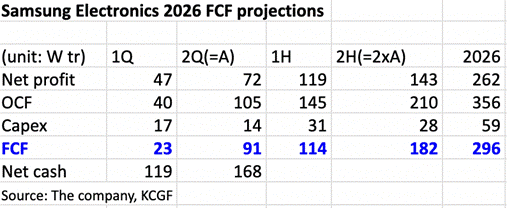
Second, issue realistic guidance. We judge the company's current estimate to be extremely conservative. At 50% of the company's own 2026 FCF estimate, the W90–110tr midpoint implies a full-year figure of roughly W200tr. Yet the Forum's simple calculation (W296tr, see table below) and brokers' projections (Mirae Asset W266tr; Hyundai Motor Securities W298tr) diverge widely from the company's number. KCGF annualized FCF estimate by doubling Q2 results, in which the memory boom is fully embedded; on that assumption, the 2026 FCF return could reach W148tr (as opposed to W100tr mid-point provided by the company) We emphasize this simple annualised estimate is a reference point for direction only. Critically, Samsung Electronics must disclose a transparent reconciliation of its policy-based FCF with its accounting-based cash flow, so that the market can verify the numbers.
We object to the FCF formula deductions. We cannot accept the company's disclosed practice of deducting "advance payments received under memory product LTAs (Long-Term Agreements), which are in the nature of deposits, and expenditures related to share-based performance compensation for employees and executives.” This is "straining at a gnat to swallow a camel" — small-minded folly. Because the calculation method is opaque, even a W100tr payout will not win back shareholder trust.
The core defect is the opacity of the FCF formula itself. The company should disclose the formula with clarity, separating (i) the advance receipt, revenue recognition, and return/reversal conditions of LTA prepayments, and (ii) non-cash expenses related to stock compensation from actual treasury-stock acquisitions. We recall the precedent in which the company's arbitrary interpretation of the EVA formula used to determine bonuses became a source of labor-management conflict; an opaque FCF formula will provoke the same level of shareholder backlash.
An advance payment is a current liability. A rise in current liabilities mechanically raises FCF — so the deduction appears intended to sever that linkage. But if LTA is a signal of structural change in the memory industry, it is wrong to exclude advance payments, in our view. Advance payments have very high visibility of conversion into revenue over time; the company itself told investors in its Q2 results that these are deposits intended to strengthen the binding force of long-term supply contracts. Money that holds customers captive eventually returns as revenue. Even if, as the company suggests, the deducted amount is added back upon revenue, the time value of money enjoyed by the company removes any reason to deduct now.
Similarly, treasury shares for employee stock-based compensation is financing activities in the cash flow statement — unrelated to that FCF computation. Even Samsung's own quarterly disclosures treat acquisition of treasury stock as a financing cash flow. The company's rationale therefore departs from accounting principles and global standards.
Third, shift the shareholder-return framework from an FCF basis to a "target capital structure policy." This requires board deliberation and the help of external experts (investment banks, consultants). Apple, from 2018 to early 2026, pursued a goal of net-cash neutrality — aligning debt and cash — and reduced its net cash by over $100bn. In 2026 it formally abandoned the target (reasoning that cash and debt should be valued separately), but this remains a successful example of a board setting an explicit, multi-year target capital structure and steadily executing against it. In its most recent quarter Apple held net cash of $62bn or W87tr, while Samsung Electronics had a net cash balance of W168tr as of 2Q.
We urge the Samsung Electronics board, through deliberation and resolution, to set an appropriate level of excess cash for the company and to communicate it to shareholders through disclosure. Competitor Micron Technology's shareholder-return policy is to "return 100% of excess cash — that is, cash beyond what the business requires over the long term — to shareholders." SanDisk operates on the same principle. The alternative of returning 75% of FCF to shareholders, as Elliott proposed to Samsung Electronics in 2016, is also available — but under that approach, too, net cash would accumulate and erode the efficiency of financial metrics such as ROE.
Assuming the KCGF-estimated annual FCF of W296tr is maintained, the FCF Samsung Electronics generates in just two years would total roughly W600tr — a scale comparable to Korea's foreign-exchange reserves (US$428 billion as of end-July). If the company intends to retain half of that, the board must deliberate intensely over the specific uses and the necessity and persuade its shareholders. Where the retained cash cannot generate a return on invested capital (ROIC) above the cost of capital, returning it to shareholders is the principle of capital allocation.
Fourth, on the composition of this shareholder-return policy. The characteristic of this disclosure is that it provides only a W30tr Q3 cash dividend guidance; there is no buyback (with the exception of the purchase for employee-compensation purpose). This suggests that the Samsung Life issue acts as a constraint on the scale and form (buyback vs. cash dividend) of Samsung Electronics' shareholder return. The conflict between Samsung Life's participating policy holders and Chairman JY Lee has now mutated into a conflict between Samsung Electronics' minority shareholders and Chairman Lee — and the Samsung Life issue is implicated in limiting Samsung's return quantum and the mix of buyback versus payout.
If Samsung Electronics buys back and cancels its shares, the ownership portions of Samsung Life and Samsung Fire & Marine stakes in Samsung Electronics rise mechanically and collide with the 10% cap under Act on the Structural Improvement of the Financial Industry (금산법) — the structural reason its payouts skew to dividends rather than to buyback-and-cancel. Yet Samsung Life and Samsung Fire already pre-reserved the 10% cap by selling W1.4tr of Samsung Electronics stock in a block deal as early as March this year. It is difficult to see why Samsung Electronics cannot comply with the rule through such stake monetisation and expand buybacks and cancels. From the minority shareholder's perspective, a cash dividend creates tax inefficiency; a buyback and cancellation does not. The minority shareholder is ultimately bearing tax inefficiency in order to preserve the existing control structure.
The company has not disclosed how the ownership ratios of Samsung Life and Samsung Fire, the legal cap under Act on the Structural Improvement of the Financial Industry, and the accounting and legal issues surrounding participating policyholders affected this payout decision. But since cash dividends vs. buyback-and-cancellation decisions can affect Samsung Life and the controlling shareholder's economic interests differently, a potential conflict of interest cannot be ruled out. The board should, with independent directors as the centre, review the impact of each return option and disclose the reasoning.
Lastly, in the current undervaluation-phase context, we further recommend the board resolve in favor of buybacks and cancellations rather than dividends, concentrated on the 26%-discounted preferred shares rather than common shares. For employee compensation buybacks, the programs should buy preferred shares in proportion to their issue ratio so as to align the interests of both preferred and common shareholders.
We ask Samsung to immediately publish a formal value-up disclosure that includes the cost of capital for both preferred and common shares. The preferred alone has the market cap of about W167tr. The same money directed to preferred shares (as opposed to common) would retire roughly 35% more shares. Ultimately, we believe Samsung Electronics should be retiring all of the expensive preferred shares. To the extent preferred shares trade at a steep discount to their same economic rights, the per-share value uplift from buying and cancelling them is larger. The board should determine the mix by comparing the relative pricing, liquidity, ownership-effect under the rule, and cost of capital of common vs. preferred, and over the long term consider simplifying the share classes via a tender offer for preferreds or conversion into common.
SK hynix's shareholder-return policy disclosure last week was deeply disappointing. From the standpoint of an existing shareholder, the W40tr ADR capital increase in early July, then the 3-month W40tr buyback-and-cancellation starting mid-August, amounts to essentially no shareholder returns at all. The company's stated plan to return "at least 50% of cumulative FCF over the policy period (2025–27)" has also lost credibility given the manner in which it has been dealing with minority shareholders.
The fact that Solidigm and its parent are U.S. entities does not extinguish SK hynix's board responsibility. In deciding on capital increases, equity sales, listings, or the exercise of shareholder rights, SK hynix's directors are bound by the revised Korean Commercial Code to protect the company and the total shareholders' interests and to treat all shareholders equally. Uniquely, local reports circulated of a five-layer dual listing structure (Solidigm would be the "grandson of the grandson, SK hynix, which itself is grandson”) and the company made a formal disclosure regarding the rumor. It was also reported locally that NOH Jongwon(Kevin), Solidigm's CEO and until recently a president of SK hynix, left and within weeks founded a private equity fund (TechBridge Investment) in California to buy stakes in Solidigm. We were perplexed. We request the disclosure of not only TechBridge IM's founding shareholders but also its list of LPs.
The alleged Nasdaq listing attempt amounts to this: a five-tier great-great-grandchild of a company that has been loss-making suddenly enjoys a windfall and, deciding to sell equity to raise capital for the controlling shareholder. Under whose authority within the SK group's structure, and to what use, will the sale proceeds be redeployed?
A run of such news is the reason SK hynix trades at a PER of just 3x. Chairman Chey is not a member of SK hynix's board. Nevertheless, at the ADR listing event in New York in July he stated "the pace of demand growth is outstripping the pace of supply growth by a wide margin," mentioned U.S. plant consideration, and has continued to make statements in the press about domestic and foreign semiconductor investment. As SK group chairman, he speaks freely about capital allocation for investment, yet says nothing on payout to shareholders — again an image of disregarding minority shareholders that is hard to shake.
Now is not the time to contemplate a five-tier dual listing; it is the time to deliberate upon the resolution of the three-tier dual listing of SK Inc. – SK Square – SK hynix. The substantive reality of SK Square is that it is a pure holding company whose net assets consist approximately 99% of the value of its SK hynix equity. From the perspective of minority shareholders, SK Square is a vehicle whose existence no one can credibly justify — a company existing solely to maximize the control of Chairman Chey's family. The National Pension Service (NPS) holds equity stakes of 7.8% and 8.8% in SK Inc. and SK Square, respectively.
Apple's shareholder-return policy took more than five years to translate into a re-rating of equity valuation multiples. We call on the controlling shareholders, management, and — every one of — the directors of both Samsung Electronics and SK hynix to exercise that patience and to lead in the protection of the interests of all shareholders.
August 24th, 2026
Korean Corporate Governance Forum
Chairman, Namuh Rhee




Opinion on the Shareholder Return Policy of Samsung Electronics and SK hynix — "Strategic Ambiguity" as a Cause of Undervaluation, with Five Proposals for Improvement
The shareholder-return policies that Samsung Electronics and SK hynix disclosed following their board resolutions last week have thrown investors into confusion. The root cause is that both companies have chosen "strategic ambiguity" in their return policies — an approach that lays bare the conflict of interest between their controlling shareholders and their minority shareholders. Both companies have now risen to the ranks of the world's largest companies by market cap. Yet shareholder-return policies that lack transparency and visibility have reminded investors exactly why both trade at PER multiples of only 3–4x. Samsung Electronics appears to be shrinking its payouts through sundry deductions and conservative guidance. SK hynix presents genuine concerns over shareholder-rights erosion — beginning with reports of a possible U.S. listing of Solidigm — making key-man risk control an urgent priority.

If this severe undervaluation of their equities is not resolved by the March 2027 AGM, the management of both companies must be prepared to step down. The directors of Samsung Electronics and SK hynix cannot escape responsibility for the undervaluation either. We accordingly consider it appropriate for institutional investors (including the National Pension Service) and foreign investors — the general body of minority shareholders — to seriously weigh voting against the re-election of directors whose terms expire at next year's AGM. We urge both companies to internalise that they are no longer the manufacturers of a developing nation, but global marquee companies of the world's top-20 by market cap, and that every investor on earth is watching. If they fail to master and conform to global standards, they risk being cast out of the market.
Samsung Electronics' announcement of an annual guidance (approximately W90–110tr for 2026) by board resolution is a meaningful first. Apple's board similarly authorized a further $100 billion of share buybacks at end-April. Best-class US companies operate on the principle of returning excess cash to shareholders; like Apple, they set a buyback authorization limit and allow the board to buy aggressively whenever it judges the stock underpriced.
Returning 50% of FCF is, to be sure, a restricted distribution, in our view. But Samsung's resolution is nevertheless significant in that it re-established the foundational principle that directors are agents of shareholders, and that distributions of residual claim must be decided in terms of maximizing shareholder value — i.e., from the standpoint of capital allocation. Choosing the optimal combination of reinvestment in capex, R&D, and M&A, the payment of performance remuneration, cash dividends, or share repurchases — whichever maximizes shareholder welfare — is plainly a core duty of the board.
We acknowledge Samsung's effort to honour its 3-year shareholder-return commitment, however insufficient. If the following five matters are improved, the company's equity valuation multiple could improve dramatically.
First, expand visibility. Extend the annual shareholder-return guidance through 2027. Given the rise in long-term agreements (LTAs), a 12-to-18-month outlook is not a difficult estimate. As with Apple, the Samsung board should authorize a buyback limit.
Second, issue realistic guidance. We judge the company's current estimate to be extremely conservative. At 50% of the company's own 2026 FCF estimate, the W90–110tr midpoint implies a full-year figure of roughly W200tr. Yet the Forum's simple calculation (W296tr, see table below) and brokers' projections (Mirae Asset W266tr; Hyundai Motor Securities W298tr) diverge widely from the company's number. KCGF annualized FCF estimate by doubling Q2 results, in which the memory boom is fully embedded; on that assumption, the 2026 FCF return could reach W148tr (as opposed to W100tr mid-point provided by the company) We emphasize this simple annualised estimate is a reference point for direction only. Critically, Samsung Electronics must disclose a transparent reconciliation of its policy-based FCF with its accounting-based cash flow, so that the market can verify the numbers.
We object to the FCF formula deductions. We cannot accept the company's disclosed practice of deducting "advance payments received under memory product LTAs (Long-Term Agreements), which are in the nature of deposits, and expenditures related to share-based performance compensation for employees and executives.” This is "straining at a gnat to swallow a camel" — small-minded folly. Because the calculation method is opaque, even a W100tr payout will not win back shareholder trust.
The core defect is the opacity of the FCF formula itself. The company should disclose the formula with clarity, separating (i) the advance receipt, revenue recognition, and return/reversal conditions of LTA prepayments, and (ii) non-cash expenses related to stock compensation from actual treasury-stock acquisitions. We recall the precedent in which the company's arbitrary interpretation of the EVA formula used to determine bonuses became a source of labor-management conflict; an opaque FCF formula will provoke the same level of shareholder backlash.
An advance payment is a current liability. A rise in current liabilities mechanically raises FCF — so the deduction appears intended to sever that linkage. But if LTA is a signal of structural change in the memory industry, it is wrong to exclude advance payments, in our view. Advance payments have very high visibility of conversion into revenue over time; the company itself told investors in its Q2 results that these are deposits intended to strengthen the binding force of long-term supply contracts. Money that holds customers captive eventually returns as revenue. Even if, as the company suggests, the deducted amount is added back upon revenue, the time value of money enjoyed by the company removes any reason to deduct now.
Similarly, treasury shares for employee stock-based compensation is financing activities in the cash flow statement — unrelated to that FCF computation. Even Samsung's own quarterly disclosures treat acquisition of treasury stock as a financing cash flow. The company's rationale therefore departs from accounting principles and global standards.
Third, shift the shareholder-return framework from an FCF basis to a "target capital structure policy." This requires board deliberation and the help of external experts (investment banks, consultants). Apple, from 2018 to early 2026, pursued a goal of net-cash neutrality — aligning debt and cash — and reduced its net cash by over $100bn. In 2026 it formally abandoned the target (reasoning that cash and debt should be valued separately), but this remains a successful example of a board setting an explicit, multi-year target capital structure and steadily executing against it. In its most recent quarter Apple held net cash of $62bn or W87tr, while Samsung Electronics had a net cash balance of W168tr as of 2Q.
We urge the Samsung Electronics board, through deliberation and resolution, to set an appropriate level of excess cash for the company and to communicate it to shareholders through disclosure. Competitor Micron Technology's shareholder-return policy is to "return 100% of excess cash — that is, cash beyond what the business requires over the long term — to shareholders." SanDisk operates on the same principle. The alternative of returning 75% of FCF to shareholders, as Elliott proposed to Samsung Electronics in 2016, is also available — but under that approach, too, net cash would accumulate and erode the efficiency of financial metrics such as ROE.
Assuming the KCGF-estimated annual FCF of W296tr is maintained, the FCF Samsung Electronics generates in just two years would total roughly W600tr — a scale comparable to Korea's foreign-exchange reserves (US$428 billion as of end-July). If the company intends to retain half of that, the board must deliberate intensely over the specific uses and the necessity and persuade its shareholders. Where the retained cash cannot generate a return on invested capital (ROIC) above the cost of capital, returning it to shareholders is the principle of capital allocation.
Fourth, on the composition of this shareholder-return policy. The characteristic of this disclosure is that it provides only a W30tr Q3 cash dividend guidance; there is no buyback (with the exception of the purchase for employee-compensation purpose). This suggests that the Samsung Life issue acts as a constraint on the scale and form (buyback vs. cash dividend) of Samsung Electronics' shareholder return. The conflict between Samsung Life's participating policy holders and Chairman JY Lee has now mutated into a conflict between Samsung Electronics' minority shareholders and Chairman Lee — and the Samsung Life issue is implicated in limiting Samsung's return quantum and the mix of buyback versus payout.
If Samsung Electronics buys back and cancels its shares, the ownership portions of Samsung Life and Samsung Fire & Marine stakes in Samsung Electronics rise mechanically and collide with the 10% cap under Act on the Structural Improvement of the Financial Industry (금산법) — the structural reason its payouts skew to dividends rather than to buyback-and-cancel. Yet Samsung Life and Samsung Fire already pre-reserved the 10% cap by selling W1.4tr of Samsung Electronics stock in a block deal as early as March this year. It is difficult to see why Samsung Electronics cannot comply with the rule through such stake monetisation and expand buybacks and cancels. From the minority shareholder's perspective, a cash dividend creates tax inefficiency; a buyback and cancellation does not. The minority shareholder is ultimately bearing tax inefficiency in order to preserve the existing control structure.
The company has not disclosed how the ownership ratios of Samsung Life and Samsung Fire, the legal cap under Act on the Structural Improvement of the Financial Industry, and the accounting and legal issues surrounding participating policyholders affected this payout decision. But since cash dividends vs. buyback-and-cancellation decisions can affect Samsung Life and the controlling shareholder's economic interests differently, a potential conflict of interest cannot be ruled out. The board should, with independent directors as the centre, review the impact of each return option and disclose the reasoning.
Lastly, in the current undervaluation-phase context, we further recommend the board resolve in favor of buybacks and cancellations rather than dividends, concentrated on the 26%-discounted preferred shares rather than common shares. For employee compensation buybacks, the programs should buy preferred shares in proportion to their issue ratio so as to align the interests of both preferred and common shareholders.
We ask Samsung to immediately publish a formal value-up disclosure that includes the cost of capital for both preferred and common shares. The preferred alone has the market cap of about W167tr. The same money directed to preferred shares (as opposed to common) would retire roughly 35% more shares. Ultimately, we believe Samsung Electronics should be retiring all of the expensive preferred shares. To the extent preferred shares trade at a steep discount to their same economic rights, the per-share value uplift from buying and cancelling them is larger. The board should determine the mix by comparing the relative pricing, liquidity, ownership-effect under the rule, and cost of capital of common vs. preferred, and over the long term consider simplifying the share classes via a tender offer for preferreds or conversion into common.
SK hynix's shareholder-return policy disclosure last week was deeply disappointing. From the standpoint of an existing shareholder, the W40tr ADR capital increase in early July, then the 3-month W40tr buyback-and-cancellation starting mid-August, amounts to essentially no shareholder returns at all. The company's stated plan to return "at least 50% of cumulative FCF over the policy period (2025–27)" has also lost credibility given the manner in which it has been dealing with minority shareholders.
The fact that Solidigm and its parent are U.S. entities does not extinguish SK hynix's board responsibility. In deciding on capital increases, equity sales, listings, or the exercise of shareholder rights, SK hynix's directors are bound by the revised Korean Commercial Code to protect the company and the total shareholders' interests and to treat all shareholders equally. Uniquely, local reports circulated of a five-layer dual listing structure (Solidigm would be the "grandson of the grandson, SK hynix, which itself is grandson”) and the company made a formal disclosure regarding the rumor. It was also reported locally that NOH Jongwon(Kevin), Solidigm's CEO and until recently a president of SK hynix, left and within weeks founded a private equity fund (TechBridge Investment) in California to buy stakes in Solidigm. We were perplexed. We request the disclosure of not only TechBridge IM's founding shareholders but also its list of LPs.
The alleged Nasdaq listing attempt amounts to this: a five-tier great-great-grandchild of a company that has been loss-making suddenly enjoys a windfall and, deciding to sell equity to raise capital for the controlling shareholder. Under whose authority within the SK group's structure, and to what use, will the sale proceeds be redeployed?
A run of such news is the reason SK hynix trades at a PER of just 3x. Chairman Chey is not a member of SK hynix's board. Nevertheless, at the ADR listing event in New York in July he stated "the pace of demand growth is outstripping the pace of supply growth by a wide margin," mentioned U.S. plant consideration, and has continued to make statements in the press about domestic and foreign semiconductor investment. As SK group chairman, he speaks freely about capital allocation for investment, yet says nothing on payout to shareholders — again an image of disregarding minority shareholders that is hard to shake.
Now is not the time to contemplate a five-tier dual listing; it is the time to deliberate upon the resolution of the three-tier dual listing of SK Inc. – SK Square – SK hynix. The substantive reality of SK Square is that it is a pure holding company whose net assets consist approximately 99% of the value of its SK hynix equity. From the perspective of minority shareholders, SK Square is a vehicle whose existence no one can credibly justify — a company existing solely to maximize the control of Chairman Chey's family. The National Pension Service (NPS) holds equity stakes of 7.8% and 8.8% in SK Inc. and SK Square, respectively.
Apple's shareholder-return policy took more than five years to translate into a re-rating of equity valuation multiples. We call on the controlling shareholders, management, and — every one of — the directors of both Samsung Electronics and SK hynix to exercise that patience and to lead in the protection of the interests of all shareholders.
August 24th, 2026
Korean Corporate Governance Forum
Chairman, Namuh Rhee