Chairman Chey's W944bn Sale of SK Inc Shares — Is There an ‘Implicit’ Agreement?
- This sale requires an explanation as to whether it is designed to circumvent the aggregate 3% rule ahead of next year's AGM
- From the standpoint of enhancing shareholder value, a merger of SK Inc. and SK Square would help resolve the holding-company discount. Let’s begin by addressing the elimination of local three-tier duplicate listing
- A foreign listing such as Solidigm's is, self-evidently, a duplicate listing as well
- The Forum requests disclosure as to whether there are any SK-related persons among the founding shareholders — or among the LPs — of the holding company and asset management company established in the US this year by former SK hynix President NOH Jongwon (Kevin) (who also served as CEO of Solidigm), in whom a serious conflict of interest may arise
SK Inc. and Korea Investment Holdings disclosed on October 2nd that Chairman Tony Chey intends to dispose of 1,653,924 shares of SK Inc.: W544bn of which is to be sold to a strategic investor, with the remaining W400bn transacted with Korea Investment & Securities, a fully owned subsidiary of Korea Investment Holdings, on a price return swap (PRS) basis. The total transaction value of W944bn matches precisely the property division the local court ordered payable to Director ROH Soh Yeong. Actual settlement of the sale begins on November 2nd, one month after the disclosure.
The identity of the strategic investor has not yet been specified. SK Inc. has explained only that the acquirer decided to purchase a portion of Chey's stake "in consideration of the company's business competitiveness and medium- to long-term growth potential." Chey has pledged responsible management, growth strategy and investment plans, corporate value enhancement and shareholder value enhancement notwithstanding the sale.
What is notable is that this sale did not adopt the ordinary block-trade route of selling the stake to foreign or local institutional investors, and that there are only two counterparties — a strategic investor and a single domestic securities firm. Given the undervaluation of SK Inc. equities, had Chey's side conducted a bookbuilding exercise among local institutions and foreign investors, the response would very likely have been strong, in our view. The comparison is with POSCO Holdings’ disposal of its entire holding in Woori Financial Group (equivalent to W676.5 bn), held for some ten years, via block trade on October 1st, and with the case in which HONG Ra-hee, LEE Boo-jin and LEE Seo-hyun — mother and daughters of JY Lee — sold approximately W10.3tr of Samsung affiliate shares over five years to fund inheritance tax. In the cases of the POSCO and Samsung founding families alike, the ordinary block-trade method was chosen.
The Forum notes that both acquirers are capable of exercising voting rights over the SK Inc. shares. Under a PRS, all legal rights — voting rights, dividend rights and the right of disposal — transfer to the acquirer together with the share transfer, with only the profit or loss on share price movement typically settled after the fact. These transactions amount to 2.3% of issued shares, but reaches 3.0% once treasury shares, which carry no voting rights, are excluded. As a result of the transactions, Chey's voting-right stake falls from 23.9% to 20.8%, and the Chey family stake including specially related persons falls from 33.5% to 30.5%.
It remains to be seen whether, following this sale, the strategic investor and Korea Investment & Securities, the PRS investor, will be disclosed as joint holders with Chey. Under the amended Korean Commercial Code, listed companies with an assets threshold of W2tr or more — including SK Inc. — and listed companies with an enhanced audit committee will be subject to the strengthened "3% rule" (the aggregate 3% rule) at the March 2027 AGM. This rule recognises voting rights of no more than 3% in aggregate, counting the holdings of the largest shareholder and specially related persons together, when appointing audit committee members. This is the first test in which the aggregate 3% rule, cumulative voting and e-voting apply across the board at an AGM, working in combination to enhance the rights of general shareholders. In practice, many listed companies construct shareholding structures that circumvent the 3% rule — through reciprocal cross-shareholdings, de facto nominee arrangements, ties of interest with business counterparties, or employee share ownership schemes, based on our observation.
If both the strategic investor and Korea Investment & Securities are investors friendly to Chey, and there is an "implicit" agreement that they will exercise their voting rights in the same direction as he does, they must be disclosed as joint holders. Even absent a written contract, a mere "agreement" suffices to constitute joint holders. Failure to disclose them as joint holders notwithstanding this is a violation of the Capital Markets Act.
The very concept of a "strategic investor" denotes an investor sharing a common interest, so that the concept itself necessarily implies an agreement to exercise voting rights jointly — and the likelihood is therefore high that such an investor will be regarded as a joint holder under the Capital Markets Act. A PRS ordinarily creates only an economic profit-and-loss relationship, and thus constitutes a mechanism that circumvents the "agreement to jointly hold or direct voting rights" requirement under the current Enforcement Decree of the Capital Markets Act. Should Korea Investment & Securities in fact exercise its voting rights in a manner favourable to Chey on matters where his interest diverges from that of general shareholders, a side agreement may be inferred.
Under the Capital Markets Act and its subordinate legislation, the determination of a large holding (“5% or higher”) is made not by the person alone but by aggregating that person with specially related persons. Specially related persons include not only persons in a special relationship but also persons who have agreed to acquire or dispose of shares jointly, or to exercise voting rights jointly (joint holders). Pursuant to the FSC's interpretation of October 21st 2019, an agreement among joint holders requires no writing and a verbal concurrence of intent suffices.
Chey is a business leader representing the Korean business community and is also Chairman of the Korea Chamber of Commerce and Industry. He is placed where he above all others must set the example. If the concealed purpose of these transactions is the stable maintenance of control, he should take the straightforward path and remain faithful to the spirit of the amended Commercial Code — "the protection of the interests of all shareholders and fair and equitable treatment."
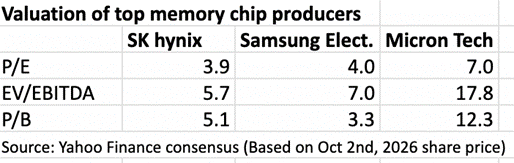
Dismantle the domestic duplicate-listing structure running from SK Inc. to SK Square to SK hynix, and halt the Nasdaq listing of Solidigm, a five-tier duplicate listing as a grandson company of SK hynix. If the share prices and equity valuations of SK Inc., SK Square and SK hynix were raised two- to three-fold from their present undervalued levels, there would be no need for concern over control from the Chey perspective. As the table below shows, SK hynix remains undervalued relative to Samsung Electronics on P/E and EV/EBITDA bases notwithstanding its July ADR listing, and severely undervalued relative to Micron. (Samsung Electronics' unusually low P/B multiple is the result of excessive overcapitalization arising from more than two decades of neglect of shareholder returns.)
The market judges that the anomalous dual holding-company structure — unprecedented anywhere in the world — is the cause of both Chey's and SK Inc.'s substantially low effective stake in SK hynix, and of SK hynix's lacklustre shareholder returns and abnormal five-tier duplicate-listing attempt relative to overseas competitors. It exploits a pyramid structure to the maximum, giving rise to conflicts of interest with general shareholders. A pyramid ownership structure built through multiple listings creates a wide divergence between voting rights and cashflow rights. The controlling shareholder at the top of the pyramid receives only a minuscule portion of the cashflow, and therefore has an incentive not to pursue efficient capital allocation through shareholder returns or to weigh business risk prudently when investing, but rather to build an empire to widen his influence, or to construct structures for the appropriation of private benefits and for tunneling.
From the standpoint of enhancing shareholder value, a merger of SK Inc. and SK Square is worth considering. The substance of SK Square is a pure holding company in which 99% of net assets consist of the value of its SK hynix stake. From the perspective of general shareholders, SK Square is a company whose reason for existence no one can explain, existing solely to maximise the control of Chey's family. Should a merger be pursued, an active role by the National Pension Service (NPS), which holds 7.8% of SK Inc. and 8.8% of SK Square respectively, will be necessary. Chey and the boards of SK Inc., SK Square and SK hynix must urgently present shareholders with a roadmap to reduce the number of pyramid tiers in line with global standards, instead of scheming to add tiers.
Whether in Korea or abroad, the spin-off and listing of a core business division, and the listing of an existing subsidiary, are alike duplicate listings that destroy the value of the parent. The ink on SK hynix's July US listing documents had scarcely dried when reports emerged that its grandson company Solidigm would proceed to an IPO in the US — stunning news from the standpoint of existing shareholders of SK hynix. From Chey's perspective, Solidigm is a great-grandson company — the grandson of a grandson (SK hynix).
Moreover, former SK hynix President NOH Jongwon (Kevin) — who served as President of SK hynix and until mid-year as CEO of Solidigm — has, according to press reports, recently established a private equity fund in the US and is pursuing trillion-won-scale investment in Solidigm, raising grave concerns of conflict of interest. He is reported to have established Noh Capital Partners US LLC as the holding company and TechBridge Investment LP as the asset management company. The Forum requests disclosure as to whether there are any SK-related persons — among the founding shareholders of the holding company and asset management company, and among the LPs — in whom a serious conflict of interest may arise.
October 6th, 2026
Korean Corporate Governance Forum
Chairman, Namuh Rhee




Chairman Chey's W944bn Sale of SK Inc Shares — Is There an ‘Implicit’ Agreement?
SK Inc. and Korea Investment Holdings disclosed on October 2nd that Chairman Tony Chey intends to dispose of 1,653,924 shares of SK Inc.: W544bn of which is to be sold to a strategic investor, with the remaining W400bn transacted with Korea Investment & Securities, a fully owned subsidiary of Korea Investment Holdings, on a price return swap (PRS) basis. The total transaction value of W944bn matches precisely the property division the local court ordered payable to Director ROH Soh Yeong. Actual settlement of the sale begins on November 2nd, one month after the disclosure.
The identity of the strategic investor has not yet been specified. SK Inc. has explained only that the acquirer decided to purchase a portion of Chey's stake "in consideration of the company's business competitiveness and medium- to long-term growth potential." Chey has pledged responsible management, growth strategy and investment plans, corporate value enhancement and shareholder value enhancement notwithstanding the sale.
What is notable is that this sale did not adopt the ordinary block-trade route of selling the stake to foreign or local institutional investors, and that there are only two counterparties — a strategic investor and a single domestic securities firm. Given the undervaluation of SK Inc. equities, had Chey's side conducted a bookbuilding exercise among local institutions and foreign investors, the response would very likely have been strong, in our view. The comparison is with POSCO Holdings’ disposal of its entire holding in Woori Financial Group (equivalent to W676.5 bn), held for some ten years, via block trade on October 1st, and with the case in which HONG Ra-hee, LEE Boo-jin and LEE Seo-hyun — mother and daughters of JY Lee — sold approximately W10.3tr of Samsung affiliate shares over five years to fund inheritance tax. In the cases of the POSCO and Samsung founding families alike, the ordinary block-trade method was chosen.
The Forum notes that both acquirers are capable of exercising voting rights over the SK Inc. shares. Under a PRS, all legal rights — voting rights, dividend rights and the right of disposal — transfer to the acquirer together with the share transfer, with only the profit or loss on share price movement typically settled after the fact. These transactions amount to 2.3% of issued shares, but reaches 3.0% once treasury shares, which carry no voting rights, are excluded. As a result of the transactions, Chey's voting-right stake falls from 23.9% to 20.8%, and the Chey family stake including specially related persons falls from 33.5% to 30.5%.
It remains to be seen whether, following this sale, the strategic investor and Korea Investment & Securities, the PRS investor, will be disclosed as joint holders with Chey. Under the amended Korean Commercial Code, listed companies with an assets threshold of W2tr or more — including SK Inc. — and listed companies with an enhanced audit committee will be subject to the strengthened "3% rule" (the aggregate 3% rule) at the March 2027 AGM. This rule recognises voting rights of no more than 3% in aggregate, counting the holdings of the largest shareholder and specially related persons together, when appointing audit committee members. This is the first test in which the aggregate 3% rule, cumulative voting and e-voting apply across the board at an AGM, working in combination to enhance the rights of general shareholders. In practice, many listed companies construct shareholding structures that circumvent the 3% rule — through reciprocal cross-shareholdings, de facto nominee arrangements, ties of interest with business counterparties, or employee share ownership schemes, based on our observation.
If both the strategic investor and Korea Investment & Securities are investors friendly to Chey, and there is an "implicit" agreement that they will exercise their voting rights in the same direction as he does, they must be disclosed as joint holders. Even absent a written contract, a mere "agreement" suffices to constitute joint holders. Failure to disclose them as joint holders notwithstanding this is a violation of the Capital Markets Act.
The very concept of a "strategic investor" denotes an investor sharing a common interest, so that the concept itself necessarily implies an agreement to exercise voting rights jointly — and the likelihood is therefore high that such an investor will be regarded as a joint holder under the Capital Markets Act. A PRS ordinarily creates only an economic profit-and-loss relationship, and thus constitutes a mechanism that circumvents the "agreement to jointly hold or direct voting rights" requirement under the current Enforcement Decree of the Capital Markets Act. Should Korea Investment & Securities in fact exercise its voting rights in a manner favourable to Chey on matters where his interest diverges from that of general shareholders, a side agreement may be inferred.
Under the Capital Markets Act and its subordinate legislation, the determination of a large holding (“5% or higher”) is made not by the person alone but by aggregating that person with specially related persons. Specially related persons include not only persons in a special relationship but also persons who have agreed to acquire or dispose of shares jointly, or to exercise voting rights jointly (joint holders). Pursuant to the FSC's interpretation of October 21st 2019, an agreement among joint holders requires no writing and a verbal concurrence of intent suffices.
Chey is a business leader representing the Korean business community and is also Chairman of the Korea Chamber of Commerce and Industry. He is placed where he above all others must set the example. If the concealed purpose of these transactions is the stable maintenance of control, he should take the straightforward path and remain faithful to the spirit of the amended Commercial Code — "the protection of the interests of all shareholders and fair and equitable treatment."
Dismantle the domestic duplicate-listing structure running from SK Inc. to SK Square to SK hynix, and halt the Nasdaq listing of Solidigm, a five-tier duplicate listing as a grandson company of SK hynix. If the share prices and equity valuations of SK Inc., SK Square and SK hynix were raised two- to three-fold from their present undervalued levels, there would be no need for concern over control from the Chey perspective. As the table below shows, SK hynix remains undervalued relative to Samsung Electronics on P/E and EV/EBITDA bases notwithstanding its July ADR listing, and severely undervalued relative to Micron. (Samsung Electronics' unusually low P/B multiple is the result of excessive overcapitalization arising from more than two decades of neglect of shareholder returns.)
The market judges that the anomalous dual holding-company structure — unprecedented anywhere in the world — is the cause of both Chey's and SK Inc.'s substantially low effective stake in SK hynix, and of SK hynix's lacklustre shareholder returns and abnormal five-tier duplicate-listing attempt relative to overseas competitors. It exploits a pyramid structure to the maximum, giving rise to conflicts of interest with general shareholders. A pyramid ownership structure built through multiple listings creates a wide divergence between voting rights and cashflow rights. The controlling shareholder at the top of the pyramid receives only a minuscule portion of the cashflow, and therefore has an incentive not to pursue efficient capital allocation through shareholder returns or to weigh business risk prudently when investing, but rather to build an empire to widen his influence, or to construct structures for the appropriation of private benefits and for tunneling.
From the standpoint of enhancing shareholder value, a merger of SK Inc. and SK Square is worth considering. The substance of SK Square is a pure holding company in which 99% of net assets consist of the value of its SK hynix stake. From the perspective of general shareholders, SK Square is a company whose reason for existence no one can explain, existing solely to maximise the control of Chey's family. Should a merger be pursued, an active role by the National Pension Service (NPS), which holds 7.8% of SK Inc. and 8.8% of SK Square respectively, will be necessary. Chey and the boards of SK Inc., SK Square and SK hynix must urgently present shareholders with a roadmap to reduce the number of pyramid tiers in line with global standards, instead of scheming to add tiers.
Whether in Korea or abroad, the spin-off and listing of a core business division, and the listing of an existing subsidiary, are alike duplicate listings that destroy the value of the parent. The ink on SK hynix's July US listing documents had scarcely dried when reports emerged that its grandson company Solidigm would proceed to an IPO in the US — stunning news from the standpoint of existing shareholders of SK hynix. From Chey's perspective, Solidigm is a great-grandson company — the grandson of a grandson (SK hynix).
Moreover, former SK hynix President NOH Jongwon (Kevin) — who served as President of SK hynix and until mid-year as CEO of Solidigm — has, according to press reports, recently established a private equity fund in the US and is pursuing trillion-won-scale investment in Solidigm, raising grave concerns of conflict of interest. He is reported to have established Noh Capital Partners US LLC as the holding company and TechBridge Investment LP as the asset management company. The Forum requests disclosure as to whether there are any SK-related persons — among the founding shareholders of the holding company and asset management company, and among the LPs — in whom a serious conflict of interest may arise.
October 6th, 2026
Korean Corporate Governance Forum
Chairman, Namuh Rhee