To Chairman Chey and SK hynix BoD Chairman Ko — we urge immediate termination of discussion on alleged listing of Solidigm in the US through five-tier dual listing, and call instead for deliberation on unwinding of domestic three-tier dual-listing structure
- The 3x P/E multiple reflects key-man risk. Chairman Chey and the board must accept the market's warning with humility
- Solidigm is a "great-great-grandchild" enterprise — a 5-Tier dual listing without global precedent in terms of listing aspiration. Solidigm is a grandchild of SK hynix, which is itself a grandchild of SK Inc. The Forum calls for the immediate termination of the discussion to "export the Korea Discount" to overseas exchanges. Now is not the time to deepen the pyramid ownership structure; it is instead the moment to deliberate on unwinding the three-tier dual listing of SK Inc. – SK Square – SK hynix
- The notion that investments conducted through an US legal entity could evade the oversight of the National Assembly, the government, and investors is a fundamental miscalculation. It is consistent with the spirit of the revised Korean Commercial Code that the principle prohibiting dual listing should be applied with equal force to overseas subsidiaries, just as it constrains domestic subsidiaries
- Chairman Chey should pose a direct question to Jensen Huang: why does NVIDIA maintain no subsidiary dual listing whatsoever? Taiwan's TSMC likewise maintains no listed subsidiaries
- The proposed capital calls by SK Telecom, SK Inc., and SK Innovation into Solidigm's US parent presage potential inter-shareholder wealth transfer
- What have the SK hynix directors done to protect the interests of general shareholders in respect of either the government's mega-project announcements or the alleged Solidigm dual listing? Any individual director may request that an item be placed on the board's agenda.
The 3x P/E multiple embodies key-man risk — a market signal that must be heeded. According to Morgan Stanley, SK hynix trades at a P/E of approximately 3x (based on 12-month forward earnings estimates). In general, a share price that is extraordinarily depressed relative to earnings reflects one or more of the following: (1) accounting irregularities; (2) erroneous earnings forecasts; (3) peaking earnings cycle; or (4) distrust of the controlling shareholder, management, and the board of directors.
A flagship Korean enterprise presents, in our assessment, essentially no likelihood of accounting fraud. It appears plausible that, on 2027–28 forecasts, the P/E may be 5–6x rather than 3x. This would be the case where the denominator of the P/E formula — namely, earnings — proves materially smaller than consensus projections. If production capacity is expanded and output thereby increased (despite semi analysts' denials of this dynamic), chip prices will decline. This is precisely the reason memory manufacturers have increasingly entered into long-term supply agreements (LTAs) to secure revenue stability. The earnings cycle may well turn within one to two years. Memory is among the most volatile of the hundreds of industrial sectors. Per JP Morgan, SK hynix is projected to generate W811tr in FCF over the next three years (W213tr in 2026, W265tr in 2027, and W333tr in 2028). The market, it appears, does not credit the brokerage FCF estimates for 2026–28 — which approach 80% of current market cap — and instead harbors concern that the earnings peak is approaching.
The fundamental reason a national-champion blue chip trades at a mere 3x P/E is that investors do not believe that the several hundred trillion won of annual FCF generated by SK hynix (after capex and R&D expenditure) will ever accrue to the benefit of general shareholders. Moreover, expectations for general shareholder protection from the six independent directors who remained silent on the three mega projects are, regrettably, remote.
The KCGF has repeatedly noted the expectation that ADR issuance would enable SK hynix to command a valuation comparable to that of US semi companies is profoundly naïve. The key-man risk surrounding Chairman Chey is simply too substantial, in our view. Any meaningful equity valuation multiple re-rating is conditional upon sustained, transformative improvements in corporate governance. In ordinary commercial logic, when the earnings outlook of a grandchild company's subs and associated entities improve, the rational course is to retain or even increase one's equity stake. Conversely, when local media speculation circulates regarding a dilution or divestment of that stake, investors' apprehension is a natural and understandable response.
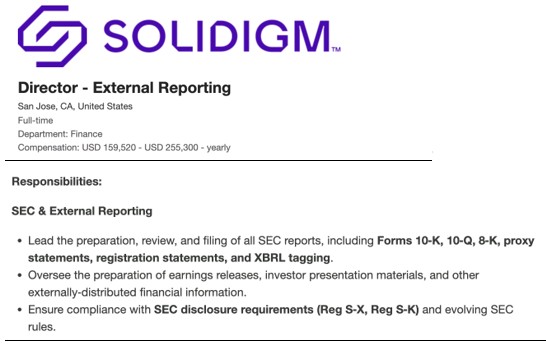
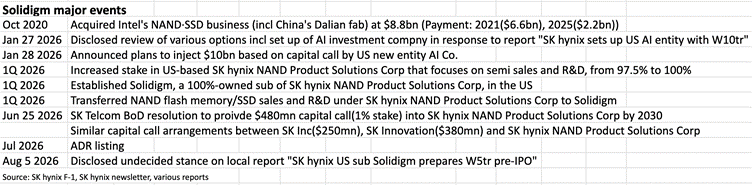
The company's unconfirmed clarification disclosure regarding the August 5th local report — "SK hynix's US subsidiary Solidigm pursues a pre-IPO of approximately W5 tr" — has served only to intensify suspicions of key-man risk. While the domestic press characterizes the Solidigm listing as a four-tier dual listing, in essence, it constitutes a five-tier dual listing, according to our research. The complexity of the equity structure of SK hynix's US subsidiary — a grandchild company from Chairman Chey's vantage — is considerable, and a multiplicity of equity transactions have already been executed this year (see table). In the lead-up to its July ADR listing, SK hynix — under the coaching of its book runners (J.P. Morgan, Bank of America, Goldman Sachs, and Citi) — appears to have been preparing the Solidigm listing with considerable sophistication. The recent recruitment advertisement by Solidigm for an IR Director with demonstrated experience in quarterly/annual results disclosure at a US-listed company and in dealings with the US SEC strongly suggests that, following a pre-IPO, the likelihood of a formal listing is high.
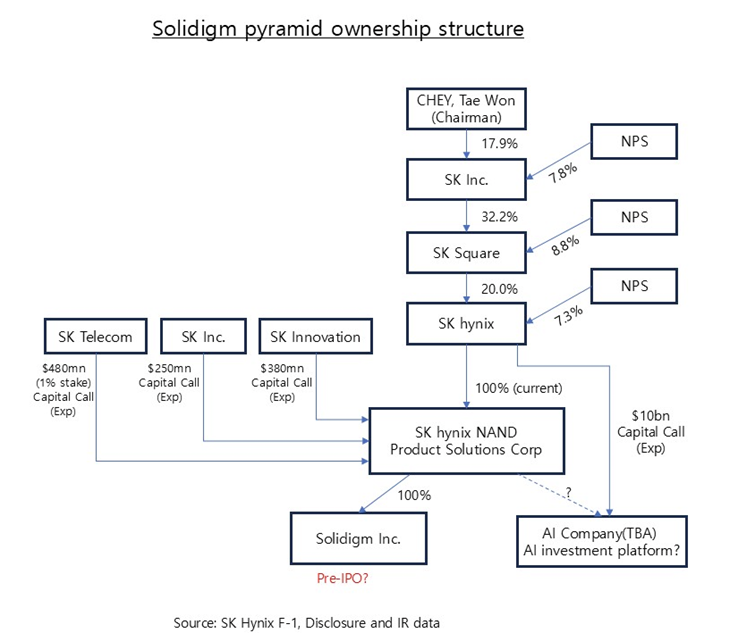
Should Solidigm proceed with a listing on Nasdaq, it would constitute an exceedingly rare, five-tier dual listing without global parallel. Solidigm constitutes a great-great-grandchild (고손 or 현손) enterprise — that is, the grandchild of a grandchild (SK hynix). Contrary to domestic press coverage (and notwithstanding the ambiguity of even SK hynix's own newsletter), SK hynix does not hold a direct equity interest in Solidigm. According to the Form F-1, SK hynix currently holds a 100% equity interest in its US subsidiary, SK hynix NAND Product Solutions Corp., and this entity in turn owns a 100% equity interest in Solidigm Inc., a newly incorporated US entity established during the first quarter of the current year.
It is a misapprehension to believe that investments conducted through a US legal entity can evade the surveillance of Korean financial regulators, the National Assembly, and investors. If the duty of loyalty of directors to shareholders operates to restrict the dual listing of domestic subs, then the prohibition principle must, by logical necessity, be extended to overseas subs and overseas grandchild companies as well. Solidigm is the transferee of Intel's former NAND/SSD division. After years of substantial losses, it is now enjoying an historic boom. It is conceivable that the controlling shareholder, wedded to prior bad practices, may be tempted to divest a portion of Solidigm's equity through a pre-IPO and an official IPO, to raise capital in the US, and to redeploy those proceeds into AI and other ventures. The Intel NAND/SSD business — long regarded as an acquisition failure — now makes a meaningful contribution to SK hynix earnings, yet this contribution comes only after the deployment of the US$8.8 billion acquisition price. We urge that the rights and interests of the general shareholders who patiently endured the intervening losses not be infringed. We respectfully urge Chairman Chey to pose a direct question to his close associate, Jensen Huang, asking why NVIDIA maintains no dual listing of subsidiaries whatsoever. Taiwan's TSMC likewise has no listed subsidiaries at all.
The Fair Trade Act permits only three tiers; accordingly, virtually all domestic dual listings terminate at the third tier. Korea's pyramid ownership structures are thereby prevented from unlimited expansion domestically. Regrettably, however, the three-tier limitation under the Fair Trade Act does not extend to overseas affiliates. As a pyramid ownership structure expands across multiple tiers, economic power becomes increasingly concentrated in a single individual at the apex. Through the combination of a minimal equity stake with external equity capital and leverage, an individual can dominate an enormous corporate empire. ("empire building”) As the experience of Korean conglomerates demonstrates, general shareholders find it exceedingly difficult to check this pyramid-style concentration of economic power.
In a pyramid structure, the divergence between voting rights and cash-flow rights is pronounced. Because the controlling shareholder of the apex holding company receives only a negligible fraction of the cash flows, there exists an incentive — rather than pursuing efficient capital allocation through shareholder returns or prudently weighing economic risk in investment — to expand the business further so as to broaden personal influence, or to construct structures conducive to self-dealing and tunneling.
In practice, Chairman Chey receives only a minuscule fraction of SK hynix's cash dividends, yet he appoints the management of entities across all tiers (1 through 5) and controls their boards of directors. To illustrate: if SK hynix distributes 100 as a dividend, and those funds are re-distributed upward tier by tier — accounting for only partial application of the dividend-received deduction, the leakage of corporate income tax at intermediate stages, and, ultimately, the gross-up and dividend tax credit (excluding the effect of high-dividend separate taxation) — the cash flow ultimately received by Chairman Chey approximates 0.77. Should Solidigm proceed with a listing, the proportion of cash flow flowing upward from Solidigm would, by necessity, fall below even 0.77. At such a point, the incentive structure militates toward pursuing ever-greater "social influence" rather than the modest dividends to which the apex controller is economically entitled.
The disclosed capital calls into the Solidigm parent entity (SK hynix NAND Product Solutions Corp.) — SK Telecom ($480mn), SK Inc. ($250mn), and SK Innovation ($380mn), each pursuant to resolutions approved by their respective boards of directors through 2030 — are indicative of a potential transfer of wealth among shareholders. Such inter-shareholder wealth transfer warrants the utmost vigilance from the perspective of shareholders.
Every jurisdiction endeavors to resolve pyramid structures through explicit statutes, taxation, exchange regulations, or social pressure. In Japan, numerous dual-listing structures — such as those of Toyota and Hitachi — have been unwound. In the United States, the proportion of dual listings is a mere 0.05%. Across other advanced economies, the incidence of dual listing is likewise far lower than in Korea; indeed, even three-tier cases are rare, let alone five-tier structures. Because this situation is unfamiliar to US investors who bought into SK hynix ADRs, they may require some time to properly appreciate the significance of the alleged Solidigm US listing— and the repercussions may arrive with a time lag. If, as rumored, Solidigm were to list on Nasdaq, such an event would break with the prevailing common sense and discipline of corporate governance; accordingly, we must remain vigilant against the potential for any pyramid of four or more tiers, and for dual listings conducted through overseas entities.
What has the SK hynix board of directors done to protect the interests of shareholders in respect of either the government's mega-project announcements in July or the alleged Solidigm dual listing? Under Article 390, Paragraphs 1 and 2 of the Korean Commercial Code — which governs the convening of the board of directors — any individual director may request that an item be placed on the board's agenda. Chairman Ko and five independent directors should, consistent with their duty of care and duty of loyalty to the company and shareholders, properly request that the board formally resolve (i) the feasibility of alleged Solidigm's five-tier dual listing and (ii) whether its consummation would constitute an infringement of shareholder rights.The independence of a director is not a gift conferred or permitted by another; it is a commitment to shareholders made by a self-directed professional, to be earned and safeguarded through one's own choices and responsibilities.
Now is not the time to contemplate a five-tier dual listing; it is the time to deliberate upon the resolution of the three-tier dual listing of SK Inc. – SK Square – SK hynix. The substantive reality of SK Square is that it is a pure holding company whose net assets consist approximately 99% of the value of its SK hynix equity. From the perspective of general shareholders, SK Square is a vehicle whose existence no one can credibly justify — a company existing solely to maximize the control of Chairman Chey's family. The National Pension Service (NPS) holds equity stakes of 7.8% and 8.8% in SK Inc. and SK Square, respectively.
Numerous observers have noted that this anomalous double-tier holding company structure — rarely found even domestically — which renders the effective shareholding of Chairman Chey and SK Inc. in SK hynix conspicuously low, constitutes the root cause of SK hynix's deficient shareholder returns and of abnormal initiatives such as this attempted five-tier dual listing. We call upon Chairman Chey and the boards of SK Inc., SK Square, and SK hynix to cease devising means to expand the number of pyramid tiers and, instead, to expeditiously present to investors a roadmap for consolidation to global-standard norms.
August 18th, 2026
Korean Corporate Governance Forum
Chairman, Namuh Rhee
Auditor, Hyeseop Sim




To Chairman Chey and SK hynix BoD Chairman Ko — we urge immediate termination of discussion on alleged listing of Solidigm in the US through five-tier dual listing, and call instead for deliberation on unwinding of domestic three-tier dual-listing structure
The 3x P/E multiple embodies key-man risk — a market signal that must be heeded. According to Morgan Stanley, SK hynix trades at a P/E of approximately 3x (based on 12-month forward earnings estimates). In general, a share price that is extraordinarily depressed relative to earnings reflects one or more of the following: (1) accounting irregularities; (2) erroneous earnings forecasts; (3) peaking earnings cycle; or (4) distrust of the controlling shareholder, management, and the board of directors.
A flagship Korean enterprise presents, in our assessment, essentially no likelihood of accounting fraud. It appears plausible that, on 2027–28 forecasts, the P/E may be 5–6x rather than 3x. This would be the case where the denominator of the P/E formula — namely, earnings — proves materially smaller than consensus projections. If production capacity is expanded and output thereby increased (despite semi analysts' denials of this dynamic), chip prices will decline. This is precisely the reason memory manufacturers have increasingly entered into long-term supply agreements (LTAs) to secure revenue stability. The earnings cycle may well turn within one to two years. Memory is among the most volatile of the hundreds of industrial sectors. Per JP Morgan, SK hynix is projected to generate W811tr in FCF over the next three years (W213tr in 2026, W265tr in 2027, and W333tr in 2028). The market, it appears, does not credit the brokerage FCF estimates for 2026–28 — which approach 80% of current market cap — and instead harbors concern that the earnings peak is approaching.
The fundamental reason a national-champion blue chip trades at a mere 3x P/E is that investors do not believe that the several hundred trillion won of annual FCF generated by SK hynix (after capex and R&D expenditure) will ever accrue to the benefit of general shareholders. Moreover, expectations for general shareholder protection from the six independent directors who remained silent on the three mega projects are, regrettably, remote.
The KCGF has repeatedly noted the expectation that ADR issuance would enable SK hynix to command a valuation comparable to that of US semi companies is profoundly naïve. The key-man risk surrounding Chairman Chey is simply too substantial, in our view. Any meaningful equity valuation multiple re-rating is conditional upon sustained, transformative improvements in corporate governance. In ordinary commercial logic, when the earnings outlook of a grandchild company's subs and associated entities improve, the rational course is to retain or even increase one's equity stake. Conversely, when local media speculation circulates regarding a dilution or divestment of that stake, investors' apprehension is a natural and understandable response.
The company's unconfirmed clarification disclosure regarding the August 5th local report — "SK hynix's US subsidiary Solidigm pursues a pre-IPO of approximately W5 tr" — has served only to intensify suspicions of key-man risk. While the domestic press characterizes the Solidigm listing as a four-tier dual listing, in essence, it constitutes a five-tier dual listing, according to our research. The complexity of the equity structure of SK hynix's US subsidiary — a grandchild company from Chairman Chey's vantage — is considerable, and a multiplicity of equity transactions have already been executed this year (see table). In the lead-up to its July ADR listing, SK hynix — under the coaching of its book runners (J.P. Morgan, Bank of America, Goldman Sachs, and Citi) — appears to have been preparing the Solidigm listing with considerable sophistication. The recent recruitment advertisement by Solidigm for an IR Director with demonstrated experience in quarterly/annual results disclosure at a US-listed company and in dealings with the US SEC strongly suggests that, following a pre-IPO, the likelihood of a formal listing is high.
Should Solidigm proceed with a listing on Nasdaq, it would constitute an exceedingly rare, five-tier dual listing without global parallel. Solidigm constitutes a great-great-grandchild (고손 or 현손) enterprise — that is, the grandchild of a grandchild (SK hynix). Contrary to domestic press coverage (and notwithstanding the ambiguity of even SK hynix's own newsletter), SK hynix does not hold a direct equity interest in Solidigm. According to the Form F-1, SK hynix currently holds a 100% equity interest in its US subsidiary, SK hynix NAND Product Solutions Corp., and this entity in turn owns a 100% equity interest in Solidigm Inc., a newly incorporated US entity established during the first quarter of the current year.
It is a misapprehension to believe that investments conducted through a US legal entity can evade the surveillance of Korean financial regulators, the National Assembly, and investors. If the duty of loyalty of directors to shareholders operates to restrict the dual listing of domestic subs, then the prohibition principle must, by logical necessity, be extended to overseas subs and overseas grandchild companies as well. Solidigm is the transferee of Intel's former NAND/SSD division. After years of substantial losses, it is now enjoying an historic boom. It is conceivable that the controlling shareholder, wedded to prior bad practices, may be tempted to divest a portion of Solidigm's equity through a pre-IPO and an official IPO, to raise capital in the US, and to redeploy those proceeds into AI and other ventures. The Intel NAND/SSD business — long regarded as an acquisition failure — now makes a meaningful contribution to SK hynix earnings, yet this contribution comes only after the deployment of the US$8.8 billion acquisition price. We urge that the rights and interests of the general shareholders who patiently endured the intervening losses not be infringed. We respectfully urge Chairman Chey to pose a direct question to his close associate, Jensen Huang, asking why NVIDIA maintains no dual listing of subsidiaries whatsoever. Taiwan's TSMC likewise has no listed subsidiaries at all.
The Fair Trade Act permits only three tiers; accordingly, virtually all domestic dual listings terminate at the third tier. Korea's pyramid ownership structures are thereby prevented from unlimited expansion domestically. Regrettably, however, the three-tier limitation under the Fair Trade Act does not extend to overseas affiliates. As a pyramid ownership structure expands across multiple tiers, economic power becomes increasingly concentrated in a single individual at the apex. Through the combination of a minimal equity stake with external equity capital and leverage, an individual can dominate an enormous corporate empire. ("empire building”) As the experience of Korean conglomerates demonstrates, general shareholders find it exceedingly difficult to check this pyramid-style concentration of economic power.
In a pyramid structure, the divergence between voting rights and cash-flow rights is pronounced. Because the controlling shareholder of the apex holding company receives only a negligible fraction of the cash flows, there exists an incentive — rather than pursuing efficient capital allocation through shareholder returns or prudently weighing economic risk in investment — to expand the business further so as to broaden personal influence, or to construct structures conducive to self-dealing and tunneling.
In practice, Chairman Chey receives only a minuscule fraction of SK hynix's cash dividends, yet he appoints the management of entities across all tiers (1 through 5) and controls their boards of directors. To illustrate: if SK hynix distributes 100 as a dividend, and those funds are re-distributed upward tier by tier — accounting for only partial application of the dividend-received deduction, the leakage of corporate income tax at intermediate stages, and, ultimately, the gross-up and dividend tax credit (excluding the effect of high-dividend separate taxation) — the cash flow ultimately received by Chairman Chey approximates 0.77. Should Solidigm proceed with a listing, the proportion of cash flow flowing upward from Solidigm would, by necessity, fall below even 0.77. At such a point, the incentive structure militates toward pursuing ever-greater "social influence" rather than the modest dividends to which the apex controller is economically entitled.
The disclosed capital calls into the Solidigm parent entity (SK hynix NAND Product Solutions Corp.) — SK Telecom ($480mn), SK Inc. ($250mn), and SK Innovation ($380mn), each pursuant to resolutions approved by their respective boards of directors through 2030 — are indicative of a potential transfer of wealth among shareholders. Such inter-shareholder wealth transfer warrants the utmost vigilance from the perspective of shareholders.
Every jurisdiction endeavors to resolve pyramid structures through explicit statutes, taxation, exchange regulations, or social pressure. In Japan, numerous dual-listing structures — such as those of Toyota and Hitachi — have been unwound. In the United States, the proportion of dual listings is a mere 0.05%. Across other advanced economies, the incidence of dual listing is likewise far lower than in Korea; indeed, even three-tier cases are rare, let alone five-tier structures. Because this situation is unfamiliar to US investors who bought into SK hynix ADRs, they may require some time to properly appreciate the significance of the alleged Solidigm US listing— and the repercussions may arrive with a time lag. If, as rumored, Solidigm were to list on Nasdaq, such an event would break with the prevailing common sense and discipline of corporate governance; accordingly, we must remain vigilant against the potential for any pyramid of four or more tiers, and for dual listings conducted through overseas entities.
What has the SK hynix board of directors done to protect the interests of shareholders in respect of either the government's mega-project announcements in July or the alleged Solidigm dual listing? Under Article 390, Paragraphs 1 and 2 of the Korean Commercial Code — which governs the convening of the board of directors — any individual director may request that an item be placed on the board's agenda. Chairman Ko and five independent directors should, consistent with their duty of care and duty of loyalty to the company and shareholders, properly request that the board formally resolve (i) the feasibility of alleged Solidigm's five-tier dual listing and (ii) whether its consummation would constitute an infringement of shareholder rights.The independence of a director is not a gift conferred or permitted by another; it is a commitment to shareholders made by a self-directed professional, to be earned and safeguarded through one's own choices and responsibilities.
Now is not the time to contemplate a five-tier dual listing; it is the time to deliberate upon the resolution of the three-tier dual listing of SK Inc. – SK Square – SK hynix. The substantive reality of SK Square is that it is a pure holding company whose net assets consist approximately 99% of the value of its SK hynix equity. From the perspective of general shareholders, SK Square is a vehicle whose existence no one can credibly justify — a company existing solely to maximize the control of Chairman Chey's family. The National Pension Service (NPS) holds equity stakes of 7.8% and 8.8% in SK Inc. and SK Square, respectively.
Numerous observers have noted that this anomalous double-tier holding company structure — rarely found even domestically — which renders the effective shareholding of Chairman Chey and SK Inc. in SK hynix conspicuously low, constitutes the root cause of SK hynix's deficient shareholder returns and of abnormal initiatives such as this attempted five-tier dual listing. We call upon Chairman Chey and the boards of SK Inc., SK Square, and SK hynix to cease devising means to expand the number of pyramid tiers and, instead, to expeditiously present to investors a roadmap for consolidation to global-standard norms.
August 18th, 2026
Korean Corporate Governance Forum
Chairman, Namuh Rhee
Auditor, Hyeseop Sim