Essence of Solidigm Dual Listing Is Conflict of Interest Between Chairman Tony Chey and Minority Shareholders
SK hynix BoD Chairman Koh Should Immediately Convene Board and Resolve to Suspend Listing; Instead Devise Means of Resolving 3x P/E Undervaluation
- The Possibility of Wealth Transfer Between Shareholders
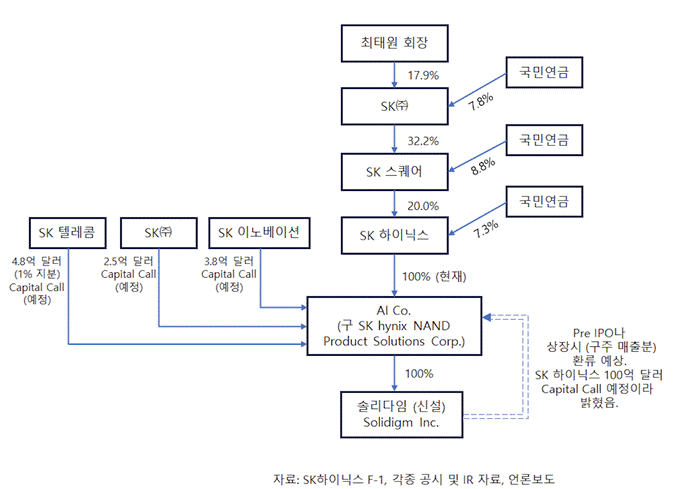
- Making the fullest use of the pyramidal ownership structure, Chairman Chey's entire interest amounts to a 1.2% indirect stake in SK hynix held through SK Inc. and SK Square — while the NPS directly holds 7.3% of SK hynix
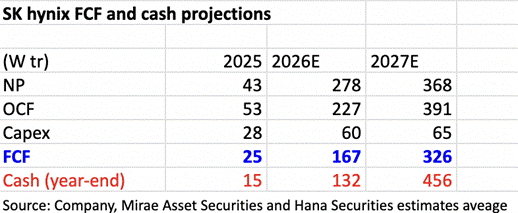
- From the standpoint of SK hynix shareholders, retaining 100% of Solidigm is preferable to selling a stake in it. Even if Solidigm requires tens of trillions of won for capex, SK hynix — with cash in abundance — need only contribute that equity capital to Solidigm through AI Co.
- Has anyone ever heard of Alphabet or Meta selling part of their stakes in YouTube or Instagram to monetise them?
- It appears the controlling shareholder Chey wishes to invest the large sums raised through Solidigm's pre-IPO or IPO in a variety of places in the US — without a resolution of the domestic SK hynix board
- We recommend that BoD Chairman Koh of SK hynix immediately convene the board, deliberate from various perspectives on the Solidigm listing — an agenda item fatal to the share price and equity valuation — and communicate the substance of that deliberation to shareholders through disclosure
- Even where the company itself suffers no loss, or where the matter accords with the business needs of the company, a violation of the amended Commercial Code may arise where the interests of some shareholders are infringed or the economic or controlling position between shareholders is altered
The essence of the Solidigm dual listing is a conflict of interest. The controlling shareholder, Chairman Tony of SK hynix (who does not even sit on the board), is in substance transferring the dilution cost exclusively to SK hynix's minority shareholders while retaining intact his control over AI Co. at the fourth tier (in the corporate holding structure) and Solidigm at the fifth tier. It is an asymmetric structure in which 100% control is preserved while Solidigm's earnings are shared.
There is also the possibility of wealth transfer between shareholders. SK Telecom (US$480mn or a 1% stake), SK Innovation (US$380mn), and SK Inc. (US$250mn) each disclosed after committing a total of US$1.11bn in capital calls into AI Co. through 2030. If the affiliated companies purchased AI Co. stakes cheaply — at an equity value of approximately US$48 billion — before listing expectations were reflected in equity value, they cannot easily escape the criticism of unfairness. This is a scenario in which part of the increase in AI Co.'s equity value to be generated by the Solidigm listing is transferred away from SK hynix and to companies in which the Chairman's interest is greater.
Under a pyramidal ownership structure, the divergence between voting rights and cash-flow rights is substantial. Until he purchased 3,620 common shares for W479mn on his own account in the market at the end of July, Chairman Chey held no SK hynix shares directly. His entire holding was a 1.2% indirect interest held through SK Inc. and SK Square. The National Pension Service (NPS), by contrast, directly holds a 7.3% stake in SK hynix. The controlling shareholder at the apex holding company receives only an extremely small fraction of the cash flows; consequently, rather than rationally weighing economic risk in decisions on shareholder returns or capex, he has an incentive first to build an empire, or to construct structures for the pursuit of private benefit and tunneling. The SK Group, which has secured maximum leverage through a five-tier duplicate listing, is the representative case.
Solidigm pyramid ownership structure (updated)
From the standpoint of SK hynix shareholders, retaining 100% of Solidigm is preferable to selling a stake in it. The only argument that could justify the conflict of interest is that "the money is absolutely necessary," and that premise does not hold: SK hynix is projected to generate free cash flow of W167tr and W326tr in 2026 and 2027 respectively. Averaging the estimates of two domestic securities firms, SK hynix will hold W132tr in cash at the end of this year and W456tr at the end of 2027. Even if Solidigm, as a second-tier US subsidiary of SK hynix, requires tens of trillions of won for capex, the answer is for SK hynix — with cash in abundance — to contribute that equity capital to Solidigm through AI Co.
Chaebol lobbying agencies and some local brokers argue that the alleged Solidigm Nasdaq listing should be viewed as the recovery and reinvestment of the acquirer's earlier investment. The assumption is that if the Intel NAND and SSD business, acquired for $9bn, is recognized at equity value of $100-150bn after listing, as some forecasts suggest, a gain of more than 11 to 17 times can be realised. But monetising a portion of the Solidigm stake is an extremely short-term way of thinking. It is economically advantageous for SK hynix shareholders to retain 100% of Solidigm and for the SK hynix directors and management to raise the equity valuation multiple above the current 3x.
Google acquired YouTube in 2006 for $1.65bn. Facebook acquired Instagram in 2012 for $1bn. Has anyone ever heard of Alphabet, Google's holding company, or Meta selling part of their stakes in YouTube or Instagram to monetise them?
It is presumed that the controlling shareholder Chey, fallen into past habits, wishes to sell part of the Solidigm stake through a pre-IPO and a formal IPO and then invest in a variety of fields in the US — without a resolution of the domestic board of SK hynix. SK hynix has stated that it will invest a total of US$10 billion in AI Co., and that this investment will be executed by way of capital calls, under which funds are paid in from time to time at AI Co.'s request. The sale of Solidigm pre-IPO shares that the press speculates about will in all likelihood be a secondary offering, and the sale proceeds appear destined to flow into AI Co.
On June 24th, the SK hynix board was formally briefed on the establishment of AI Co. (which holds 100% of Solidigm) and on its progress. It is likely that matters relating to the Solidigm listing have since been updated to the directors through informal briefings or board reporting.
According to SK hynix, SK hynix NAND Product Solutions Corp. was renamed AI Co. early this year. Just as SK Square is the domestic intermediate holding company linking SK Inc. and SK hynix, AI Co. appears to be the US intermediate holding company linking SK hynix and Solidigm.
The SK hynix board consists of ten members (two executive directors, two other non-executive directors and six independent directors). In March 2026, KOH Seung Beom, a former Chairman of the Financial Services Commission (FSC) and now an Senior Advisor at Bae, Kim & Lee LLC, was appointed Chairman of the board in a surprise move. It is customary for a director to serve at least one to two years before being appointed Chairman, in order to grasp the business; Chairman Koh was entrusted with the weighty responsibility of Chairmanship simultaneously with his appointment as a director. Independent director KIM Zeong Won also serves as an Advisor at a major law firm (Kim & Chang); one cannot but wonder how conflicts of interest with the numerous subsidiaries, second-tier subsidiaries and affiliates — including SK hynix — are being managed.
The company described the background to Chairman Koh's appointment as follows: "As a financial and economic policy expert who has served as Chairman of the FSC and as a member of the Monetary Policy Board of the Bank of Korea, he is expected to contribute to securing the company's financial soundness and to transparent management. In particular, he is expected to contribute to the creation of sustainable corporate value by enhancing the expertise and sophistication with which the company's audit committee performs its duties." SK hynix's share price has fallen by almost 60% since its peak of W3mn at the end of June. This is attributable not only to concerns over supply/demand imbalance in the memory industry but also to the continuing prominence of the possibility of a listing of its second-tier subsidiary Solidigm and of key-man risk relating to Chairman Chey.
We recommend that Chairman Koh immediately request the convening of the board, deliberate from various perspectives on the Solidigm listing — an agenda item fatal to SK hynix's share price and equity valuation — and communicate the substance of that deliberation to shareholders through disclosure. The deliberation and resolution must of course be grounded in the amended Commercial Code, which provides that "a director shall, in performing his or her duties, protect the interests of all shareholders and shall treat the interests of all shareholders fairly."
According to a recent paper by Professor LEE Sang-hun of the Kyungpook National University Law School, "Rights Issues and the Duty of Loyalty to Shareholders" the 2025 amendment to the Commercial Code is significant in that it expands the horizon of the duty of loyalty — hitherto formed around loss to the company — to the interests of shareholders and to conflicts of interest between shareholders. In particular, its significance may be most pronounced where the company itself suffers no loss, or where the matter accords with the business needs of the company, yet the interests of some shareholders are infringed or the economic or controlling position as between shareholders is altered. The mere fact that a need for funding exists at Solidigm and that the individual provisions governing secondary offerings and new share issues have been complied with, may not suffice to establish legitimacy. Now that protecting the interests of all shareholders and treating the interests of all shareholders fairly have become the legal duty of directors, the board must necessarily take the interests of SK hynix's existing shareholders into account.
October 20th, 2026
Korean Corporate Governance Forum
Chairman, Namuh Rhee




Essence of Solidigm Dual Listing Is Conflict of Interest Between Chairman Tony Chey and Minority Shareholders
SK hynix BoD Chairman Koh Should Immediately Convene Board and Resolve to Suspend Listing; Instead Devise Means of Resolving 3x P/E Undervaluation
The essence of the Solidigm dual listing is a conflict of interest. The controlling shareholder, Chairman Tony of SK hynix (who does not even sit on the board), is in substance transferring the dilution cost exclusively to SK hynix's minority shareholders while retaining intact his control over AI Co. at the fourth tier (in the corporate holding structure) and Solidigm at the fifth tier. It is an asymmetric structure in which 100% control is preserved while Solidigm's earnings are shared.

There is also the possibility of wealth transfer between shareholders. SK Telecom (US$480mn or a 1% stake), SK Innovation (US$380mn), and SK Inc. (US$250mn) each disclosed after committing a total of US$1.11bn in capital calls into AI Co. through 2030. If the affiliated companies purchased AI Co. stakes cheaply — at an equity value of approximately US$48 billion — before listing expectations were reflected in equity value, they cannot easily escape the criticism of unfairness. This is a scenario in which part of the increase in AI Co.'s equity value to be generated by the Solidigm listing is transferred away from SK hynix and to companies in which the Chairman's interest is greater.
Under a pyramidal ownership structure, the divergence between voting rights and cash-flow rights is substantial. Until he purchased 3,620 common shares for W479mn on his own account in the market at the end of July, Chairman Chey held no SK hynix shares directly. His entire holding was a 1.2% indirect interest held through SK Inc. and SK Square. The National Pension Service (NPS), by contrast, directly holds a 7.3% stake in SK hynix. The controlling shareholder at the apex holding company receives only an extremely small fraction of the cash flows; consequently, rather than rationally weighing economic risk in decisions on shareholder returns or capex, he has an incentive first to build an empire, or to construct structures for the pursuit of private benefit and tunneling. The SK Group, which has secured maximum leverage through a five-tier duplicate listing, is the representative case.
Solidigm pyramid ownership structure (updated)
From the standpoint of SK hynix shareholders, retaining 100% of Solidigm is preferable to selling a stake in it. The only argument that could justify the conflict of interest is that "the money is absolutely necessary," and that premise does not hold: SK hynix is projected to generate free cash flow of W167tr and W326tr in 2026 and 2027 respectively. Averaging the estimates of two domestic securities firms, SK hynix will hold W132tr in cash at the end of this year and W456tr at the end of 2027. Even if Solidigm, as a second-tier US subsidiary of SK hynix, requires tens of trillions of won for capex, the answer is for SK hynix — with cash in abundance — to contribute that equity capital to Solidigm through AI Co.

Chaebol lobbying agencies and some local brokers argue that the alleged Solidigm Nasdaq listing should be viewed as the recovery and reinvestment of the acquirer's earlier investment. The assumption is that if the Intel NAND and SSD business, acquired for $9bn, is recognized at equity value of $100-150bn after listing, as some forecasts suggest, a gain of more than 11 to 17 times can be realised. But monetising a portion of the Solidigm stake is an extremely short-term way of thinking. It is economically advantageous for SK hynix shareholders to retain 100% of Solidigm and for the SK hynix directors and management to raise the equity valuation multiple above the current 3x.
Google acquired YouTube in 2006 for $1.65bn. Facebook acquired Instagram in 2012 for $1bn. Has anyone ever heard of Alphabet, Google's holding company, or Meta selling part of their stakes in YouTube or Instagram to monetise them?
It is presumed that the controlling shareholder Chey, fallen into past habits, wishes to sell part of the Solidigm stake through a pre-IPO and a formal IPO and then invest in a variety of fields in the US — without a resolution of the domestic board of SK hynix. SK hynix has stated that it will invest a total of US$10 billion in AI Co., and that this investment will be executed by way of capital calls, under which funds are paid in from time to time at AI Co.'s request. The sale of Solidigm pre-IPO shares that the press speculates about will in all likelihood be a secondary offering, and the sale proceeds appear destined to flow into AI Co.
On June 24th, the SK hynix board was formally briefed on the establishment of AI Co. (which holds 100% of Solidigm) and on its progress. It is likely that matters relating to the Solidigm listing have since been updated to the directors through informal briefings or board reporting.
According to SK hynix, SK hynix NAND Product Solutions Corp. was renamed AI Co. early this year. Just as SK Square is the domestic intermediate holding company linking SK Inc. and SK hynix, AI Co. appears to be the US intermediate holding company linking SK hynix and Solidigm.
The SK hynix board consists of ten members (two executive directors, two other non-executive directors and six independent directors). In March 2026, KOH Seung Beom, a former Chairman of the Financial Services Commission (FSC) and now an Senior Advisor at Bae, Kim & Lee LLC, was appointed Chairman of the board in a surprise move. It is customary for a director to serve at least one to two years before being appointed Chairman, in order to grasp the business; Chairman Koh was entrusted with the weighty responsibility of Chairmanship simultaneously with his appointment as a director. Independent director KIM Zeong Won also serves as an Advisor at a major law firm (Kim & Chang); one cannot but wonder how conflicts of interest with the numerous subsidiaries, second-tier subsidiaries and affiliates — including SK hynix — are being managed.
The company described the background to Chairman Koh's appointment as follows: "As a financial and economic policy expert who has served as Chairman of the FSC and as a member of the Monetary Policy Board of the Bank of Korea, he is expected to contribute to securing the company's financial soundness and to transparent management. In particular, he is expected to contribute to the creation of sustainable corporate value by enhancing the expertise and sophistication with which the company's audit committee performs its duties." SK hynix's share price has fallen by almost 60% since its peak of W3mn at the end of June. This is attributable not only to concerns over supply/demand imbalance in the memory industry but also to the continuing prominence of the possibility of a listing of its second-tier subsidiary Solidigm and of key-man risk relating to Chairman Chey.
We recommend that Chairman Koh immediately request the convening of the board, deliberate from various perspectives on the Solidigm listing — an agenda item fatal to SK hynix's share price and equity valuation — and communicate the substance of that deliberation to shareholders through disclosure. The deliberation and resolution must of course be grounded in the amended Commercial Code, which provides that "a director shall, in performing his or her duties, protect the interests of all shareholders and shall treat the interests of all shareholders fairly."
According to a recent paper by Professor LEE Sang-hun of the Kyungpook National University Law School, "Rights Issues and the Duty of Loyalty to Shareholders" the 2025 amendment to the Commercial Code is significant in that it expands the horizon of the duty of loyalty — hitherto formed around loss to the company — to the interests of shareholders and to conflicts of interest between shareholders. In particular, its significance may be most pronounced where the company itself suffers no loss, or where the matter accords with the business needs of the company, yet the interests of some shareholders are infringed or the economic or controlling position as between shareholders is altered. The mere fact that a need for funding exists at Solidigm and that the individual provisions governing secondary offerings and new share issues have been complied with, may not suffice to establish legitimacy. Now that protecting the interests of all shareholders and treating the interests of all shareholders fairly have become the legal duty of directors, the board must necessarily take the interests of SK hynix's existing shareholders into account.
October 20th, 2026
Korean Corporate Governance Forum
Chairman, Namuh Rhee