KRX and foreign investors do not acknowledge treasury shares as assets
On January 30, the FSC unveiled the treasury share reform plan, which has been a subject of controversy. The reform plan includes a measure to prohibit the allocation of new shares to treasury shares in the event of a spin-off, which is known as the "treasury share magic." However, it seems to have effectively abandoned direct regulation of more serious problems such as arbitrary disposal by third parties and excessive treasury share holdings by only strengthening disclosure requirements. Listed companies are buying back more treasury shares then ever. According to a survey conducted by the Federation of Korean Industries (FKI) in May 2023, KOSPI-listed companies hold an average of 4.4% of their own shares, while the top 100 companies (by revenue) hold an average of 5.0%. Many even hold more than 30% of treasury shares, which is more than the controlling shareholder's stake.
Treasury shares in Korea: a unique case of mismatch between legal and accounting perspective in corporate governance
It is no exaggeration to say that treasury share is intricately intertwined with almost all the issues surrounding corporate governance in Korea. This is a representative example of Korean discount, where Korean companies and the capital market disregard global standards. Kumho Petrochemical despite high profitability, is trading at 0.8X of PBR (0.7X excluding treasury shares from its market cap) while facing a resurgent of management dispute on February 15th. The root of the family dispute was in the misappropriation of its 18% of outstanding shares in form of treasury shares, which were set aside for shareholder enhancement but used to defend management control, ultimately infringing upon minority shareholders’ interest. Treasury share, like Pandora's box, opens up a complex web of challenges in business, legal, and economic that only experts can navigate. The mismatch between legal and accounting, the necessity and appropriateness of management control, the rubber-stamp board members, overvalued market cap, and the positive and negative functions of M&As are just a few of the issues.
Developed markets widely apply the "treasury stock buyback = cancellation" formula
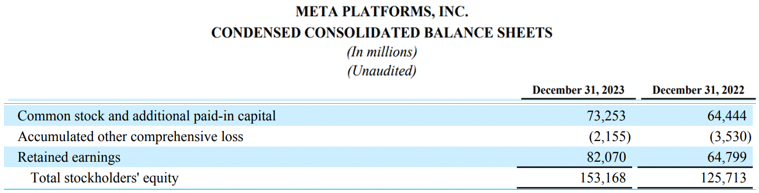
In most cases in developed markets, once shares are bought back, are immediately canceled and no longer on the company's balance sheet. Washington state, home to Microsoft's headquarters, stands out for its unique approach by prohibiting companies from holding treasury shares. This law requires companies to immediately cancel treasury shares upon buyback. In 2023, Meta canceled W27 trillion worth of treasury shares, reflecting on the balance sheet where ‘treasury share’ dedicated account does not exist (see below table). In most developed markets, treasury share buybacks without cancellation are generally not approved by the board of directors. Treasury stock cancellation can actually lead to an increase in shareholder value.
KRX and foreign investors disapprove share buybacks without cancelation
The recent survey by our forum revealed that foreign investors, including pensions and mega funds are facing significant challenges in reflecting treasury share acquired illegally (e.g. management defense purpose) in their financial ratios. Results were quite shocking; over 80% of foreign investors do not reflect treasury shares acquired with own cash in the market cap or shareholder value calculation if it is not canceled. Additionally, foreign investors with extensive experience investing in Korea were more skeptical of treasury share practice. A large US mutual fund manager criticized the Korean treasury share practice, stating that companies often sell in the market instead of canceling it, which does not reduce market cap or total outstanding shares. Also, a manager of a world-renowned sovereign wealth fund made a cynical comment that they often do not get canceled and therefore are not reflected in financial ratio calculation. KRX does not even fully take account the impact of treasury share buyback to reduce market cap size.
Violation of law to use company’s own money to defend management control of a specific shareholder
Why do Korean companies spend trillions of Won on treasury share buybacks, despite limited recognition by KRX and global financial markets? The issues surrounding treasury shares are largely unique to Korea and cannot be easily resolved using other global theories and cases.
It is clear and simple that treasury shares are purchased with 'company money'. The use, regardless of whether it is through capital reduction or asset acquisition, for the purpose of defending the management control of a specific shareholder is a clear violation of the law. This action is universally prohibited across the globe, regardless of jurisdiction.
However, arguments for using treasury stock to defend management control continue to linger. Beneath all lies the underlying assumption that 'the company benefits when the current controlling shareholder manages it.' In other words, this is the same thing as, “give the current controlling shareholder treasury shares of a bonus (even though it was purchased with company money) in addition to the existing stake.”
Court ruled that treasury share is considered a company asset
The Korean government and courts have historically allowed such ‘bonuses’ to controlling shareholders after experiencing the 1997 IMF foreign exchange crisis and the 2008 global financial crisis. The court ruled that treasury share can be disposed of in the same manner as other assets, with the Supreme Court confirming the same principle in a 2010 ruling. Additionally in 2011, the government revised the Commercial Code to exempt treasury share disposals from the same general shareholder protection procedures as new share issuances.
Presumably, there was some kind of fear underlying these government policies and court decisions. It is understandable that the government had to offer 'bonuses' to controlling shareholders of Korean companies in 1999, when foreign capital rushed into the suddenly opened stock market right after the IMF foreign exchange crisis, and in 2008, when the collapse of the global market economy was feared. These actions were taken to protect the relatively small and open Korean economy, given the demands for principled corporate governance from advanced economies with long histories of capitalism, even when Korea was not fully prepared for. However, in 2024, Korea is no longer an emerging market country. Even during the 2008 global financial crisis, there was no significant foreign capital attack through the stock market. It is widely recognized that the size of our economy and capital market has reached that of a developed country, and that we are now competing and trading as an equal member.
Time to step out of the greenhouse! Using treasury share to defend management control is no longer acceptable
Over the past 25 years, most large Korean companies have converted to holding company structures. Controlling shareholders hold an average stake of over 40% in their holding companies. The average insider’s ownership level for their entire groups, including non-holding companies, has already exceeded 60% (60.2% in 2022 and 61.6% in 2023 according to KFTC report on December 18, 2023). On that backdrop, we must no longer keep our companies in a greenhouse. With such high ownership level, anyone can easily become complacent and fall into dictatorship. Instead, we need to create a structure and situation that encourages engagement among shareholders in order to maintain companies’ vitality. There is absolutely no need to accept these additional 'bonuses' acquired with company money.
A market without competition is doomed to fail
It took Japan more than a decade to revive its stagnant companies and economy, which were paralyzed by the dominance of financial institutions and cross-holdings between large corporates during its 'lost 30 years.' Only now, through corporate governance reform, is Japan finally seeing the fruits of its long-term efforts. Should the Korean government continue to allow controlling shareholders, who own an average stake of over 40% and control their groups through holding companies and circular holdings, to receive 'bonuses' using company money? A market without competition is doomed to fail. The government must send a strong signal to the market that it will dismantle the greenhouse of treasury shares that infringe on the interests of minority shareholders. Anyone with the ability to see the higher potential value of a company should be able to manage with the support of general shareholders.
February 21, 2024
Korean Corporate Governance Forum
Chairman
Namuh Rhee




KRX and foreign investors do not acknowledge treasury shares as assets
On January 30, the FSC unveiled the treasury share reform plan, which has been a subject of controversy. The reform plan includes a measure to prohibit the allocation of new shares to treasury shares in the event of a spin-off, which is known as the "treasury share magic." However, it seems to have effectively abandoned direct regulation of more serious problems such as arbitrary disposal by third parties and excessive treasury share holdings by only strengthening disclosure requirements. Listed companies are buying back more treasury shares then ever. According to a survey conducted by the Federation of Korean Industries (FKI) in May 2023, KOSPI-listed companies hold an average of 4.4% of their own shares, while the top 100 companies (by revenue) hold an average of 5.0%. Many even hold more than 30% of treasury shares, which is more than the controlling shareholder's stake.
Treasury shares in Korea: a unique case of mismatch between legal and accounting perspective in corporate governance
It is no exaggeration to say that treasury share is intricately intertwined with almost all the issues surrounding corporate governance in Korea. This is a representative example of Korean discount, where Korean companies and the capital market disregard global standards. Kumho Petrochemical despite high profitability, is trading at 0.8X of PBR (0.7X excluding treasury shares from its market cap) while facing a resurgent of management dispute on February 15th. The root of the family dispute was in the misappropriation of its 18% of outstanding shares in form of treasury shares, which were set aside for shareholder enhancement but used to defend management control, ultimately infringing upon minority shareholders’ interest. Treasury share, like Pandora's box, opens up a complex web of challenges in business, legal, and economic that only experts can navigate. The mismatch between legal and accounting, the necessity and appropriateness of management control, the rubber-stamp board members, overvalued market cap, and the positive and negative functions of M&As are just a few of the issues.
Developed markets widely apply the "treasury stock buyback = cancellation" formula
In most cases in developed markets, once shares are bought back, are immediately canceled and no longer on the company's balance sheet. Washington state, home to Microsoft's headquarters, stands out for its unique approach by prohibiting companies from holding treasury shares. This law requires companies to immediately cancel treasury shares upon buyback. In 2023, Meta canceled W27 trillion worth of treasury shares, reflecting on the balance sheet where ‘treasury share’ dedicated account does not exist (see below table). In most developed markets, treasury share buybacks without cancellation are generally not approved by the board of directors. Treasury stock cancellation can actually lead to an increase in shareholder value.
KRX and foreign investors disapprove share buybacks without cancelation
The recent survey by our forum revealed that foreign investors, including pensions and mega funds are facing significant challenges in reflecting treasury share acquired illegally (e.g. management defense purpose) in their financial ratios. Results were quite shocking; over 80% of foreign investors do not reflect treasury shares acquired with own cash in the market cap or shareholder value calculation if it is not canceled. Additionally, foreign investors with extensive experience investing in Korea were more skeptical of treasury share practice. A large US mutual fund manager criticized the Korean treasury share practice, stating that companies often sell in the market instead of canceling it, which does not reduce market cap or total outstanding shares. Also, a manager of a world-renowned sovereign wealth fund made a cynical comment that they often do not get canceled and therefore are not reflected in financial ratio calculation. KRX does not even fully take account the impact of treasury share buyback to reduce market cap size.
Violation of law to use company’s own money to defend management control of a specific shareholder
Why do Korean companies spend trillions of Won on treasury share buybacks, despite limited recognition by KRX and global financial markets? The issues surrounding treasury shares are largely unique to Korea and cannot be easily resolved using other global theories and cases.
It is clear and simple that treasury shares are purchased with 'company money'. The use, regardless of whether it is through capital reduction or asset acquisition, for the purpose of defending the management control of a specific shareholder is a clear violation of the law. This action is universally prohibited across the globe, regardless of jurisdiction.
However, arguments for using treasury stock to defend management control continue to linger. Beneath all lies the underlying assumption that 'the company benefits when the current controlling shareholder manages it.' In other words, this is the same thing as, “give the current controlling shareholder treasury shares of a bonus (even though it was purchased with company money) in addition to the existing stake.”
Court ruled that treasury share is considered a company asset
The Korean government and courts have historically allowed such ‘bonuses’ to controlling shareholders after experiencing the 1997 IMF foreign exchange crisis and the 2008 global financial crisis. The court ruled that treasury share can be disposed of in the same manner as other assets, with the Supreme Court confirming the same principle in a 2010 ruling. Additionally in 2011, the government revised the Commercial Code to exempt treasury share disposals from the same general shareholder protection procedures as new share issuances.
Presumably, there was some kind of fear underlying these government policies and court decisions. It is understandable that the government had to offer 'bonuses' to controlling shareholders of Korean companies in 1999, when foreign capital rushed into the suddenly opened stock market right after the IMF foreign exchange crisis, and in 2008, when the collapse of the global market economy was feared. These actions were taken to protect the relatively small and open Korean economy, given the demands for principled corporate governance from advanced economies with long histories of capitalism, even when Korea was not fully prepared for. However, in 2024, Korea is no longer an emerging market country. Even during the 2008 global financial crisis, there was no significant foreign capital attack through the stock market. It is widely recognized that the size of our economy and capital market has reached that of a developed country, and that we are now competing and trading as an equal member.
Time to step out of the greenhouse! Using treasury share to defend management control is no longer acceptable
Over the past 25 years, most large Korean companies have converted to holding company structures. Controlling shareholders hold an average stake of over 40% in their holding companies. The average insider’s ownership level for their entire groups, including non-holding companies, has already exceeded 60% (60.2% in 2022 and 61.6% in 2023 according to KFTC report on December 18, 2023). On that backdrop, we must no longer keep our companies in a greenhouse. With such high ownership level, anyone can easily become complacent and fall into dictatorship. Instead, we need to create a structure and situation that encourages engagement among shareholders in order to maintain companies’ vitality. There is absolutely no need to accept these additional 'bonuses' acquired with company money.
A market without competition is doomed to fail
It took Japan more than a decade to revive its stagnant companies and economy, which were paralyzed by the dominance of financial institutions and cross-holdings between large corporates during its 'lost 30 years.' Only now, through corporate governance reform, is Japan finally seeing the fruits of its long-term efforts. Should the Korean government continue to allow controlling shareholders, who own an average stake of over 40% and control their groups through holding companies and circular holdings, to receive 'bonuses' using company money? A market without competition is doomed to fail. The government must send a strong signal to the market that it will dismantle the greenhouse of treasury shares that infringe on the interests of minority shareholders. Anyone with the ability to see the higher potential value of a company should be able to manage with the support of general shareholders.
February 21, 2024
Korean Corporate Governance Forum
Chairman
Namuh Rhee