The 10 key Value-Up missions proposed to the 22nd National Assembly
“Korea Discount is a catastrophe comparable to low birth rate issue”
Dear ruling party leader Han Dong-hoon and opposition party leader Lee Jaemyung
We, the Korean Corporate Governance Forum, are a non-profit pursuing the development of capital markets by improving corporate governance in Korea. Over 100 members actively contribute, including financial and legal professionals, academics and other experts. We fully support President Yoon Suk-yeol’s comment at the Korea Exchange (KRX) Annual Opening Ceremony on January 2nd: “We will resolve Korea discount by reforming capital market regulations.” We also endorse the “1st policy seminar on the Corporate Value-up Program” announced by Financial Supervisory Commission (FSC) with related parties such as KRX on February 26th, although it has not been finalized yet. To address the issue of Korea discount, which is as catastrophic as the low birth rate problem in our society, it is crucial that the National Assembly plays its role through legislative amendments concerning key issues.
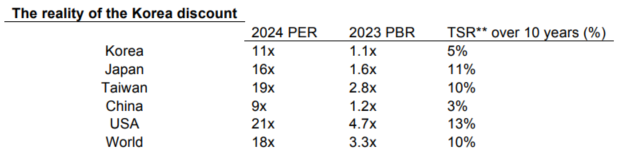
Korean blue chips getting similar valuation as Chinese peers
The stock market serves as a platform for mutual growth between the nation and corporates, and it is an avenue to wealth creation that facilitates sound asset accumulation for the general public. Korea’s leading listed companies like Samsung Electronics, Hyundai Motors, and LG Electronics manufacture world-class products, boast leadership in respective industries and have superior profitability. However, as indicated in the table, despite the recent rebound in prices, the Korean stock market is only at 50% or lower of the US, Taiwan, and world markets’ valuation, and 60% of the Japan’s valuation. It is hard to believe that the Korean valuation multiple is similar to that of the Chinese market, which have been rejecting free market principles and is gradually becoming isolated from the global economy.
The reason for the Korea discount could be found in the TSR (Total Shareholder Return). It is a global standard that quantifies shareholders’ total return. Based on experiences, we believe almost no Korean CEO has grasped the TSR for the past 1, 5, and 10 years for his/her company. Over the past decade, Korean shareholders have received a TSR of 5%, including a 2% dividend yield. This is about half of the returns in Japan, Taiwan, and the world, and only 38% of the US. Despite having the cash and/or cashflow, holding companies of large conglomerates neglect shareholder returns via dividends or buyback/cancellation. This includes actions like LG Chemical’s split-off and listing of LG Energy Solution or Hyundai Motor’s development of Global Business Center (GBC) in downtown Gangnam, which clearly infringe upon the interests of minority shareholders, while only benefiting controlling shareholders. Additionally, placing retired individuals with backgrounds from authoritative institutions (such as tax office, fair trade commision) on the board of directors, as seen in E-mart’s case, can compromise the board’s independence.
LG Electronics shareholder policy disappointing with CEO announcing 2030 forecasts that do not make sense
While 14 million local retail investors thrilled with the hopes of the Value-up Program, LG Electronics promised a dividend payout ratio of 25% and a minimum dividend payout of W1,000/share in the new 3-year plan for shareholders return policy announced on March 26th. In our view, this is an insult to general shareholders that the firm with a share price that fell 17% in the past year and 40% in the past three years, promised a 1% dividend yield that fails to even meet a commercial bank’s deposit rate. The company’s average dividend yield in the past five years has been 0.9%. LG Electronics CEO Cho Joo-wan unveiled the '2030 Vision' at the AGM on the same day, setting ambitious goals of W100 trillion in revenue, 7% growth, 7% profitability, and a 7 times in corporate value. This translates to an annual 32% increase in stock price and a market capitalization of W116 trillion by 2030. But how can LG suddenly transform itself and increase its corporate value by 32% annually when its share price has risen only 3% annually for the last ten years with a 4% operating margin? We are skeptical. We suggest LG Electronics non-executive directors Lee Sang Goo, Kang Soo Jin, Yoo Choong Yeul, and Seo Seung Woo to carefully reflect and challenge the CEO’s ‘2030 Future Vision’ during the next board meeting.
22.5 million NPS subscribers are all victims of Korea discount
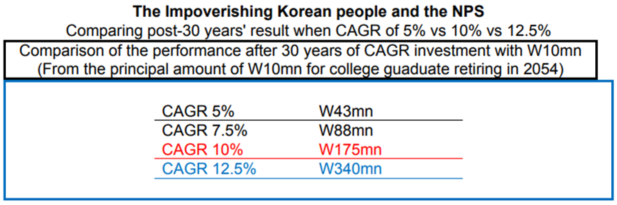
22.5 million National Pension Service (NPS) subscribers have indirectly, and 14 million market participants have directly suffered from the Korea discount. NPS’ Korea equity weighting is 14 percent of its total assets. If a new college graduate invests W10 million in Korean equities and realizes a mere 5% annual return like in the past due to Korea discount, the principle will increase to W43 million after 30 years. On the other hand, if Korean corporates resolve the Korea discount and achieve an annual return rate of 10%, like Japan and Taiwan, the principal amount will surge to W175 million by 2054. Assuming the best case, if the Korean stocks can generate returns like the US (12.5% annually), the principal will surge to W340 million. Annual compound annual growth rates of 5%, 10%, and 12.5% yield very different outcomes after 30 years when the graduate will retire. Next generation’s future payouts will be different by 4 to 8 times. Whether we and our children could expect a comfortable retirement depends on the Korean corporates’ willingness to enhance shareholders' value.
Differences in the local and international perspective on Value-Up program – The key is to change the corporate behavior
Opinions are split ahead of the Value-up Program’s 2nd policy seminar and the final Guidelines that are expected late April-early May and mid to late-May respectively. Korean press and local investors expressed disappointment after the 1st policy seminar as the enforcement by the government was lacking and also there was no details. On the other hand, as seen from the foreign investors’ continuous net buying of Korean equities, expectations for the Korean government were initially low anyways by the international community (This is the consequence of disappointing Korea’s financial policies over the past few years). Furthermore, since some believed that listed Korean companies should voluntarily perform value-up under the government guidelines like in Japan, their expectations were broadly met by what was announced after the 1st policy seminar. As seen from the record-breaking number of foreign investors visiting the Korea in 1Q24, the global financial market’s interest in the Korean Value-up Program is high.
Ranking top 10 missions to accomplish Value-up
To facilitate the understanding of driving forces of the Value-up program like the FSC and the KRX, and to prevent unnecessary political arguments between the ruling and the opposition parties, our forum has ranked the top 10 Value-up missions in order of priority. This ranking is priortized based on the corporate and market valuation re- rating potential through corporate governance enhancement. Among the top 10 missions, NPS action is one that, due to low expectations, could surprisingly yield an positive surprise since Japan’s GPIF has performed as a leader among local institutions, so we, too, shall place our hopes in the NPS.
1. Adopt the board member’s fiduciary duty to all shareholders by amending the Commercial Code
According to “G20/OECD Principles of Corporate Governance”, the corporate governance framework should protect and facilitate the exercise of shareholders’ rights and ensure the equitable treatment of all shareholders, including minority and foreign shareholders. As the governor of the Financial Supervisory Service(FSS), Lee Bok-hyeon, commented on February 28th 2024, the Commercial Code reform for fiduciary duty for shareholders is necessary. The amendments of Commercial Code need support from the Ministry of Justice and more importantly require the majority support at the National Assembly.
2. After announcing very detailed value-up template, heads and executives at the financial authorities must encourage listed companies to execute
The value-up process should be driven by the board of directors to generate sustanable results. The board should review, announce, and execute a detailed action plan after analyzing the cost of equity, return on equity/investment, share price valuation, etc. Here, the “detailed” and the “cost of capital" is important. The reality is that most board members lack basic accounting and finance knowledge, so the BoD should invite specialists (consultants, investment bankers etc), to help directors equip with basic knowledge and skills to perform their duties. This is the first step toward an independent board. We hope the heads, executives, and officers at the FSC, FSS, and KRX visit or get in touch with CEOs and executives of Korean listed companies to check their understanding of the template and encourage its adoption.
3. Mandatory stock cancellation (immediate cancellation of existing treasury shares, future share cancellation within next three months upon share buyback)
Treasury shares are not a means of defence for control by the controlling families. Since treasury shares are bought back with the corporate’s cash rather than the controlling families’ cash, treasury shares cannot be used to control purpose. If the treasury shares remain on the balance sheet, they serve discount factors. We suggest adopting new clause in the Articles of Incorporation to cancel any treasury shares within the first three months after their buybacks. Treasury share in Korea best represents a mismatch between the law and accounting regarding governance and ignorance of global standards.
In most cases in developed markets, once shares are bought back, are immediately cancelled and no longer on the company's balance sheet. The state of Washington, prohibits companies from holding treasury shares. This law thus requires companies to immediately cancel treasury shares upon buyback. In 2023, Meta purchased and cancelled about $20billion worth of treasury shares, thus treasury share account does not exist on balance sheet.
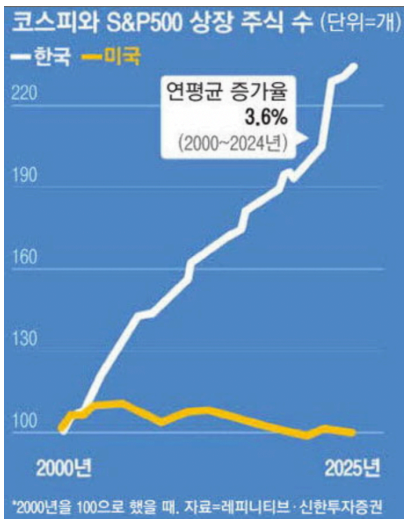
In developed markets, treasury share buybacks without cancellation would not be approved by the board of directors. The recent survey by our Forum revealed that 80% of foreign investors do not reflect treasury shares in the market cap or per share value (EPS, DPS etc) calculation if it is not cancelled. KRX does not even fully take account the impact of treasury share buyback to adjust market cap. Since 2000, the number of outstanding shares in Korea has increased by 4% annually largely due to lack of treasury stock cancellations. By contrast, despite its high number of new listings, the US has seen no increase in the number of shares due to consistent treasury stock cancellations. Now, the difference in stock market performance between the US and Korea is understandable.
Increase in number of outstanding shares since 2000 (Korea +4% pa vs. US zero growth)
4. Introduce separate taxation and lower rate for dividend income
Significant problems are associated with applying a maximum 50% tax rate on the dividend income when the total financial income exceeds W20 million per annum, even for long-term investors. This is not only dual taxation but also a hesitant factor for long-term investors to allocate more money in Korean equities. This is a harsh taxation for the middle-aged and the elderly who pursue dividend income in stable cash generating businesses. The controlling shareholders would be subject to the highest tax rate too, therefore discouraging high dividends. Hong Kong and Singapore do not have a dividend income tax, and the US adopted separate taxation on dividend income at a 15% rate when holding shares for more than a year. Adopting separate taxation for dividend income would be rational.
5. Ensure NPS’s stewardship code is fully operational and increase allocation to Korean stocks
Global investors are paying very close attention to the role of NPS in the Value-up Program. This is because GPIF’s role in Japan’s governance reformation was crucial. GPIF is well renowned for following the exact stewardship code, and Japanese institutional investors follow GPIF as the leader symbol in the market. FSS has recently announced its plan to disclose the names of local asset management companies that have exercised their voting rights irresponsibly. This move is expected to promote responsible voting practices. We suggest NPS fully disclose internal committees’ decisions and their evidence in detail whenever performing their voting rights to their website two to three weeks prior to the AGM. Other institutions also need to disclose one week ahead of the AGM when they exercise their voting rights (status quo). In retrospect, NPS has demonstrated wise decisions to have relatively light weighting in the Korean market. NPS domestic equity exposure stands at 14% of total assets compared to Japan's GPIF at 25%. This is a clear "adverse home bias" case. With the Value-up initiatives as a catalyst, we hope that NPS will lead the re-rating of the Korean shares by a significant increase in allocation to domestic equities funds.
6. Reinforce the board’s independence.
Global investors are interested in the composition and operation of Korean companies’ boards of directors because boards are the core governance bodies that protect the interest of general shareholders. They endorse our Forum’s joint program with the Ewha Womans University Graduate School of Business Women Outside Directors Program and wish there were more directors’ programs in Korea. Our Forum is considering launching other programs to educate directors. As our Forum already announced model Articles of Incorporation (to be translated into English soon) in early March, we suggest having a 1-year term for independent directors with annual re-election. We also propose one of independent directors to become a chairman of the board. We advise forming the Audit Committee and Compensation Committee only with independent directors and having two people (currently one) for the separate election of the Audit Committee.
7. Tax benefit for corporates with consistent dividend increase
The government is considering providing corporate tax cuts for listed companies that increase dividend payout and actively cancel treasury shares. While it is commendable that the government encourages shareholder returns via tax cut, the effect will be reduced if the benefits of corporate tax cuts are not for long-term and expire after a brief period. For this purpose, the revision of the Corporate Tax Act is well in need and a comparative analysis of international compatibility is also required.
8. Activate a warning system for potential delisting.
Demand that listed companies whose shareholder returns (dividends + treasury share buybacks/cancellations) decrease compared to the previous year are required to disclose the reasons in detail (“Comply or explain”). In particular, listed companies that have not made efforts to improve shareholder value for a long period of time or whose ROE has continuously deteriorated due to excessive cash and/or surplus retained earnings (ie, overcapitalization) will be ordered to delist after the warning system is activated.
9. Evaluate at fair value when the listed parent+subsidiary or affiliates merge
The valuation method using the market price (ie share price) when the parent- subsidiary or afffilates merge have the high possibility of violating general shareholders’ rights, as seen from the case of the merger between Cheil Worldwide and Samsung C&T. The Samsung C&T merger caused significant damage to minority shareholders, while the controlling shareholder Lee family benefited as a result. ISS and Sustinvest —the proxy advisory firms— were against the merger decision. In 2018, Hyundai Motor Group sought to spin off the attractive module AS parts business from Mobis and merge it at a questionable merger ratio with Hyundai Glovis controlled by the Chung family. However, this plan was thwarted as proxy advisory firms Glass Lewis and Sustinvest opposed the move, and one of major shareholders Elliott strongly objected and eventually led to the proposal to fall through. In such mergers, it is reasonable to assess the value based on fair value and to place the burden of proving fair value on the corporate itself.
10. Adjusting inheritance tax and gift tax
Chaebol lobbying associations and select local media controlled by chaebol claim that the high inheritance tax rate is one of major reasons for the Korea discount, which in our view is unsubstantiated. Until recently Korea’s big four financial holding companies’ valuations were lower than those by China’s big 4 banks controlled by the the Chinese Communist Party KB, Shinhan, Very low valuation at Hana, and Woori Financial Group was largely due to government intervention and selfish management (ie, Group Chairman and his executive team) rather than controlling shares (that did not exist).
While it is true that Korea’s inheritance tax rates are excessive, a more significant problem lies in the irrational tax system that calculates inheritance tax solely based on market value. This system favors bad controlling shareholders who intentionally lower share prices of listed entities to reduce their inheritance tax burden. We recommend levying taxes based on the higher value between book value and market value, while simultaneously lowering tax rates to a reasonable level. The government can lower tax rates without reducing tax revenue. However, the change requires approval at the National Assembley. Before any further discussion on inheritance and gift tax, controlling shareholders of listed Korean companies should demonstrate clear and tangible efforts to improve corporate governance.
April 5, 2024
Korean Corporate Governance Forum
Chairman
Namuh Rhee




The 10 key Value-Up missions proposed to the 22nd National Assembly
“Korea Discount is a catastrophe comparable to low birth rate issue”
Dear ruling party leader Han Dong-hoon and opposition party leader Lee Jaemyung
We, the Korean Corporate Governance Forum, are a non-profit pursuing the development of capital markets by improving corporate governance in Korea. Over 100 members actively contribute, including financial and legal professionals, academics and other experts. We fully support President Yoon Suk-yeol’s comment at the Korea Exchange (KRX) Annual Opening Ceremony on January 2nd: “We will resolve Korea discount by reforming capital market regulations.” We also endorse the “1st policy seminar on the Corporate Value-up Program” announced by Financial Supervisory Commission (FSC) with related parties such as KRX on February 26th, although it has not been finalized yet. To address the issue of Korea discount, which is as catastrophic as the low birth rate problem in our society, it is crucial that the National Assembly plays its role through legislative amendments concerning key issues.
Korean blue chips getting similar valuation as Chinese peers
The stock market serves as a platform for mutual growth between the nation and corporates, and it is an avenue to wealth creation that facilitates sound asset accumulation for the general public. Korea’s leading listed companies like Samsung Electronics, Hyundai Motors, and LG Electronics manufacture world-class products, boast leadership in respective industries and have superior profitability. However, as indicated in the table, despite the recent rebound in prices, the Korean stock market is only at 50% or lower of the US, Taiwan, and world markets’ valuation, and 60% of the Japan’s valuation. It is hard to believe that the Korean valuation multiple is similar to that of the Chinese market, which have been rejecting free market principles and is gradually becoming isolated from the global economy.
The reason for the Korea discount could be found in the TSR (Total Shareholder Return). It is a global standard that quantifies shareholders’ total return. Based on experiences, we believe almost no Korean CEO has grasped the TSR for the past 1, 5, and 10 years for his/her company. Over the past decade, Korean shareholders have received a TSR of 5%, including a 2% dividend yield. This is about half of the returns in Japan, Taiwan, and the world, and only 38% of the US. Despite having the cash and/or cashflow, holding companies of large conglomerates neglect shareholder returns via dividends or buyback/cancellation. This includes actions like LG Chemical’s split-off and listing of LG Energy Solution or Hyundai Motor’s development of Global Business Center (GBC) in downtown Gangnam, which clearly infringe upon the interests of minority shareholders, while only benefiting controlling shareholders. Additionally, placing retired individuals with backgrounds from authoritative institutions (such as tax office, fair trade commision) on the board of directors, as seen in E-mart’s case, can compromise the board’s independence.
LG Electronics shareholder policy disappointing with CEO announcing 2030 forecasts that do not make sense
While 14 million local retail investors thrilled with the hopes of the Value-up Program, LG Electronics promised a dividend payout ratio of 25% and a minimum dividend payout of W1,000/share in the new 3-year plan for shareholders return policy announced on March 26th. In our view, this is an insult to general shareholders that the firm with a share price that fell 17% in the past year and 40% in the past three years, promised a 1% dividend yield that fails to even meet a commercial bank’s deposit rate. The company’s average dividend yield in the past five years has been 0.9%. LG Electronics CEO Cho Joo-wan unveiled the '2030 Vision' at the AGM on the same day, setting ambitious goals of W100 trillion in revenue, 7% growth, 7% profitability, and a 7 times in corporate value. This translates to an annual 32% increase in stock price and a market capitalization of W116 trillion by 2030. But how can LG suddenly transform itself and increase its corporate value by 32% annually when its share price has risen only 3% annually for the last ten years with a 4% operating margin? We are skeptical. We suggest LG Electronics non-executive directors Lee Sang Goo, Kang Soo Jin, Yoo Choong Yeul, and Seo Seung Woo to carefully reflect and challenge the CEO’s ‘2030 Future Vision’ during the next board meeting.
22.5 million NPS subscribers are all victims of Korea discount
22.5 million National Pension Service (NPS) subscribers have indirectly, and 14 million market participants have directly suffered from the Korea discount. NPS’ Korea equity weighting is 14 percent of its total assets. If a new college graduate invests W10 million in Korean equities and realizes a mere 5% annual return like in the past due to Korea discount, the principle will increase to W43 million after 30 years. On the other hand, if Korean corporates resolve the Korea discount and achieve an annual return rate of 10%, like Japan and Taiwan, the principal amount will surge to W175 million by 2054. Assuming the best case, if the Korean stocks can generate returns like the US (12.5% annually), the principal will surge to W340 million. Annual compound annual growth rates of 5%, 10%, and 12.5% yield very different outcomes after 30 years when the graduate will retire. Next generation’s future payouts will be different by 4 to 8 times. Whether we and our children could expect a comfortable retirement depends on the Korean corporates’ willingness to enhance shareholders' value.
Differences in the local and international perspective on Value-Up program – The key is to change the corporate behavior
Opinions are split ahead of the Value-up Program’s 2nd policy seminar and the final Guidelines that are expected late April-early May and mid to late-May respectively. Korean press and local investors expressed disappointment after the 1st policy seminar as the enforcement by the government was lacking and also there was no details. On the other hand, as seen from the foreign investors’ continuous net buying of Korean equities, expectations for the Korean government were initially low anyways by the international community (This is the consequence of disappointing Korea’s financial policies over the past few years). Furthermore, since some believed that listed Korean companies should voluntarily perform value-up under the government guidelines like in Japan, their expectations were broadly met by what was announced after the 1st policy seminar. As seen from the record-breaking number of foreign investors visiting the Korea in 1Q24, the global financial market’s interest in the Korean Value-up Program is high.
Ranking top 10 missions to accomplish Value-up
To facilitate the understanding of driving forces of the Value-up program like the FSC and the KRX, and to prevent unnecessary political arguments between the ruling and the opposition parties, our forum has ranked the top 10 Value-up missions in order of priority. This ranking is priortized based on the corporate and market valuation re- rating potential through corporate governance enhancement. Among the top 10 missions, NPS action is one that, due to low expectations, could surprisingly yield an positive surprise since Japan’s GPIF has performed as a leader among local institutions, so we, too, shall place our hopes in the NPS.
1. Adopt the board member’s fiduciary duty to all shareholders by amending the Commercial Code
According to “G20/OECD Principles of Corporate Governance”, the corporate governance framework should protect and facilitate the exercise of shareholders’ rights and ensure the equitable treatment of all shareholders, including minority and foreign shareholders. As the governor of the Financial Supervisory Service(FSS), Lee Bok-hyeon, commented on February 28th 2024, the Commercial Code reform for fiduciary duty for shareholders is necessary. The amendments of Commercial Code need support from the Ministry of Justice and more importantly require the majority support at the National Assembly.
2. After announcing very detailed value-up template, heads and executives at the financial authorities must encourage listed companies to execute
The value-up process should be driven by the board of directors to generate sustanable results. The board should review, announce, and execute a detailed action plan after analyzing the cost of equity, return on equity/investment, share price valuation, etc. Here, the “detailed” and the “cost of capital" is important. The reality is that most board members lack basic accounting and finance knowledge, so the BoD should invite specialists (consultants, investment bankers etc), to help directors equip with basic knowledge and skills to perform their duties. This is the first step toward an independent board. We hope the heads, executives, and officers at the FSC, FSS, and KRX visit or get in touch with CEOs and executives of Korean listed companies to check their understanding of the template and encourage its adoption.
3. Mandatory stock cancellation (immediate cancellation of existing treasury shares, future share cancellation within next three months upon share buyback)
Treasury shares are not a means of defence for control by the controlling families. Since treasury shares are bought back with the corporate’s cash rather than the controlling families’ cash, treasury shares cannot be used to control purpose. If the treasury shares remain on the balance sheet, they serve discount factors. We suggest adopting new clause in the Articles of Incorporation to cancel any treasury shares within the first three months after their buybacks. Treasury share in Korea best represents a mismatch between the law and accounting regarding governance and ignorance of global standards.
In most cases in developed markets, once shares are bought back, are immediately cancelled and no longer on the company's balance sheet. The state of Washington, prohibits companies from holding treasury shares. This law thus requires companies to immediately cancel treasury shares upon buyback. In 2023, Meta purchased and cancelled about $20billion worth of treasury shares, thus treasury share account does not exist on balance sheet.
In developed markets, treasury share buybacks without cancellation would not be approved by the board of directors. The recent survey by our Forum revealed that 80% of foreign investors do not reflect treasury shares in the market cap or per share value (EPS, DPS etc) calculation if it is not cancelled. KRX does not even fully take account the impact of treasury share buyback to adjust market cap. Since 2000, the number of outstanding shares in Korea has increased by 4% annually largely due to lack of treasury stock cancellations. By contrast, despite its high number of new listings, the US has seen no increase in the number of shares due to consistent treasury stock cancellations. Now, the difference in stock market performance between the US and Korea is understandable.
Increase in number of outstanding shares since 2000 (Korea +4% pa vs. US zero growth)
4. Introduce separate taxation and lower rate for dividend income
Significant problems are associated with applying a maximum 50% tax rate on the dividend income when the total financial income exceeds W20 million per annum, even for long-term investors. This is not only dual taxation but also a hesitant factor for long-term investors to allocate more money in Korean equities. This is a harsh taxation for the middle-aged and the elderly who pursue dividend income in stable cash generating businesses. The controlling shareholders would be subject to the highest tax rate too, therefore discouraging high dividends. Hong Kong and Singapore do not have a dividend income tax, and the US adopted separate taxation on dividend income at a 15% rate when holding shares for more than a year. Adopting separate taxation for dividend income would be rational.
5. Ensure NPS’s stewardship code is fully operational and increase allocation to Korean stocks
Global investors are paying very close attention to the role of NPS in the Value-up Program. This is because GPIF’s role in Japan’s governance reformation was crucial. GPIF is well renowned for following the exact stewardship code, and Japanese institutional investors follow GPIF as the leader symbol in the market. FSS has recently announced its plan to disclose the names of local asset management companies that have exercised their voting rights irresponsibly. This move is expected to promote responsible voting practices. We suggest NPS fully disclose internal committees’ decisions and their evidence in detail whenever performing their voting rights to their website two to three weeks prior to the AGM. Other institutions also need to disclose one week ahead of the AGM when they exercise their voting rights (status quo). In retrospect, NPS has demonstrated wise decisions to have relatively light weighting in the Korean market. NPS domestic equity exposure stands at 14% of total assets compared to Japan's GPIF at 25%. This is a clear "adverse home bias" case. With the Value-up initiatives as a catalyst, we hope that NPS will lead the re-rating of the Korean shares by a significant increase in allocation to domestic equities funds.
6. Reinforce the board’s independence.
Global investors are interested in the composition and operation of Korean companies’ boards of directors because boards are the core governance bodies that protect the interest of general shareholders. They endorse our Forum’s joint program with the Ewha Womans University Graduate School of Business Women Outside Directors Program and wish there were more directors’ programs in Korea. Our Forum is considering launching other programs to educate directors. As our Forum already announced model Articles of Incorporation (to be translated into English soon) in early March, we suggest having a 1-year term for independent directors with annual re-election. We also propose one of independent directors to become a chairman of the board. We advise forming the Audit Committee and Compensation Committee only with independent directors and having two people (currently one) for the separate election of the Audit Committee.
7. Tax benefit for corporates with consistent dividend increase
The government is considering providing corporate tax cuts for listed companies that increase dividend payout and actively cancel treasury shares. While it is commendable that the government encourages shareholder returns via tax cut, the effect will be reduced if the benefits of corporate tax cuts are not for long-term and expire after a brief period. For this purpose, the revision of the Corporate Tax Act is well in need and a comparative analysis of international compatibility is also required.
8. Activate a warning system for potential delisting.
Demand that listed companies whose shareholder returns (dividends + treasury share buybacks/cancellations) decrease compared to the previous year are required to disclose the reasons in detail (“Comply or explain”). In particular, listed companies that have not made efforts to improve shareholder value for a long period of time or whose ROE has continuously deteriorated due to excessive cash and/or surplus retained earnings (ie, overcapitalization) will be ordered to delist after the warning system is activated.
9. Evaluate at fair value when the listed parent+subsidiary or affiliates merge
The valuation method using the market price (ie share price) when the parent- subsidiary or afffilates merge have the high possibility of violating general shareholders’ rights, as seen from the case of the merger between Cheil Worldwide and Samsung C&T. The Samsung C&T merger caused significant damage to minority shareholders, while the controlling shareholder Lee family benefited as a result. ISS and Sustinvest —the proxy advisory firms— were against the merger decision. In 2018, Hyundai Motor Group sought to spin off the attractive module AS parts business from Mobis and merge it at a questionable merger ratio with Hyundai Glovis controlled by the Chung family. However, this plan was thwarted as proxy advisory firms Glass Lewis and Sustinvest opposed the move, and one of major shareholders Elliott strongly objected and eventually led to the proposal to fall through. In such mergers, it is reasonable to assess the value based on fair value and to place the burden of proving fair value on the corporate itself.
10. Adjusting inheritance tax and gift tax
Chaebol lobbying associations and select local media controlled by chaebol claim that the high inheritance tax rate is one of major reasons for the Korea discount, which in our view is unsubstantiated. Until recently Korea’s big four financial holding companies’ valuations were lower than those by China’s big 4 banks controlled by the the Chinese Communist Party KB, Shinhan, Very low valuation at Hana, and Woori Financial Group was largely due to government intervention and selfish management (ie, Group Chairman and his executive team) rather than controlling shares (that did not exist).
While it is true that Korea’s inheritance tax rates are excessive, a more significant problem lies in the irrational tax system that calculates inheritance tax solely based on market value. This system favors bad controlling shareholders who intentionally lower share prices of listed entities to reduce their inheritance tax burden. We recommend levying taxes based on the higher value between book value and market value, while simultaneously lowering tax rates to a reasonable level. The government can lower tax rates without reducing tax revenue. However, the change requires approval at the National Assembley. Before any further discussion on inheritance and gift tax, controlling shareholders of listed Korean companies should demonstrate clear and tangible efforts to improve corporate governance.
April 5, 2024
Korean Corporate Governance Forum
Chairman
Namuh Rhee